Venezuela’s 100-year territorial dispute is back in court
The regime claims the Essequibo region of Guyana, and its oil
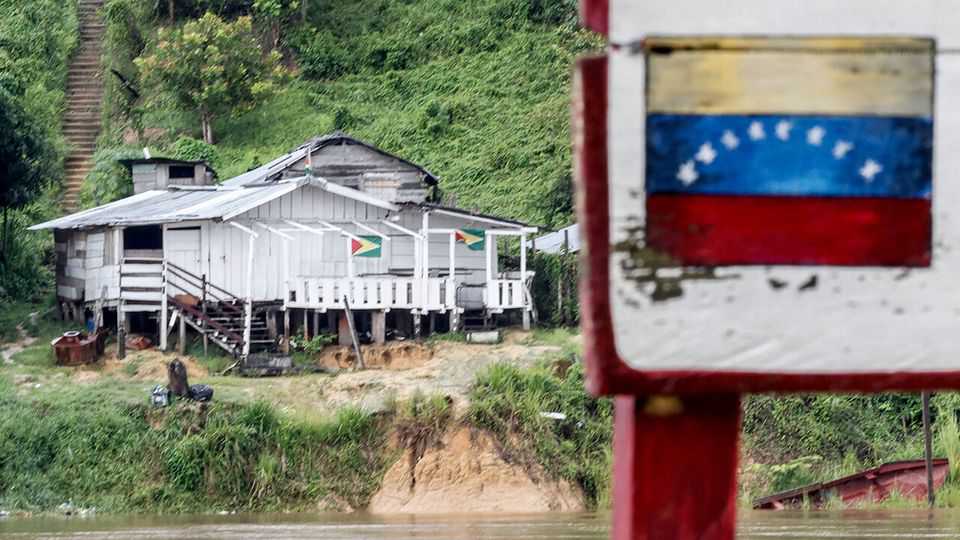
On May 4th the International Court of Justice (ICJ) in The Hague opened hearings on a territorial dispute that has dragged on for more than a century. Venezuela claims the Essequibo region—160,000 square kilometres of rainforest and villages on its eastern border which makes up two-thirds of neighbouring Guyana—as its own. Guyana calls the claim meritless and says Essequibo’s population of some 140,000 has never expressed interest in becoming Venezuelan.
The dispute stems from the 19th century. Britain, then the colonial administrator of British Guiana, and newly independent Venezuela made conflicting claims to the largely unexplored land west of the Essequibo river. In 1899 a five-judge tribunal—two American, two British and a Russian—settled the current border, with compromise on both sides. For decades after, Venezuela accepted the decision.
Only in 1962, as Guyana approached its own independence, did Venezuela demur. It said the tribunal had been rigged and that the final award was “arbitrary”. A mutual commitment made in 1966 to seek a settlement has led nowhere. The dispute has become more pressing since 2015, when vast oil reserves were discovered off Guyana’s coast. Its exploitation made Guyana the world’s fastest-growing economy.
Guyana asked the ICJ to make a final and binding ruling in 2018. Venezuela says the court has no jurisdiction, despite the fact that it has ruled twice, in 2018 and 2023, that it does. Venezuela sent its foreign minister, Yván Gil, to the new hearing, but only, as he put it, to “reveal the truth to the world”. Guyana’s lawyer told the court on May 4th that Venezuela’s case was built on “theatre and fiction”. He argued that annulling the century-old award would set a dangerous precedent for border security around the world.
The Essequibo is one issue on which almost all Venezuelans agree. Children are taught from an early age that the land is rightfully theirs. They are not told what today’s Essequibo, with its English-speaking population, is actually like. “There is this narrative from politicians and teachers that the great Venezuela, the heroic Venezuela, was stolen,” says Alexandra Panzarelli, a Venezuelan professor of Latin America studies at Marymount Manhattan College in New York. “You grow up convinced that this territory belongs to Venezuela and that eventually international justice is going to do something about it.”
In 2023 the regime of Nicolás Maduro escalated Venezuela’s claim by holding a referendum, which it said overwhelmingly backed annexation (no one in Essequibo was consulted). It subsequently announced the creation of a new Venezuelan state called Guayana Esequiba and ordered new maps incorporating the territory to be displayed across the country. A governor to the area was elected in Venezuela’s controversial regional elections last year, by a paltry 21,000 voters on Venezuela’s side of the border.
The judgment of the ICJ may come within months. In theory it will be final. In practice Venezuela, which President Donald Trump now claims to “run”, is likely to ignore it. Power to enforce it lies with the United Nations Security Council; it has never successfully done so with such a contentious ICJ decision. ■