UniCredit’s lowball bid for Commerzbank causes consternation
A bad-tempered battle for a big German bank
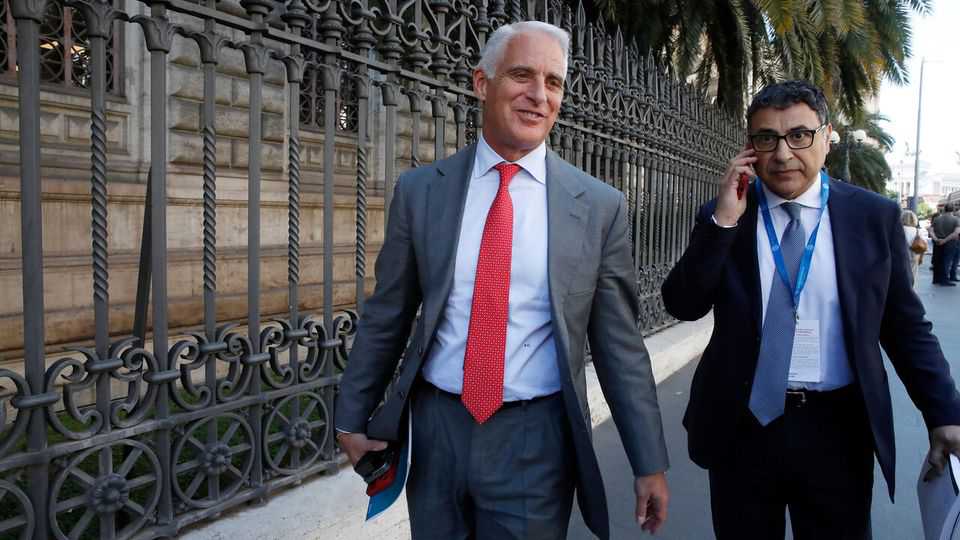
The offer was not a surprise. On May 5th UniCredit, Italy’s second-biggest bank, made a bid for all the shares it does not already own in Commerzbank, Germany’s second-biggest listed lender—as it had promised in mid-March. Until June 16th Commerzbank’s shareholders can swap one share for 0.485 of UniCredit’s. It is not an enticing proposition: the implied price is more than 8% below Commerzbank’s closing mark on May 4th. The bid values the whole bank at €35bn ($41bn).
Why has UniCredit made such a stingy offer? Pragmatism, its bosses say. The bid pre-empts a provision in German law that obliges a shareholder owning more than 30% of a listed company to make an offer for the rest. They envisage two scenarios for how things will play out. One is a continuation of the status quo. UniCredit, which owns just under 30% of Commerzbank, in effect controls 36% already, once total-return swaps (derivative contracts that separate credit and market risk from formal ownership) are counted, says Paola Sabbione of Barclays, a British bank. The other is full control, the ultimate aim of Andrea Orcel, UniCredit’s chief executive.
UniCredit already owns HypoVereinsbank (HVB), another leading German lender. With Commerzbank, it would have around 9% of the German market by revenue. The pair would complement each other: Commerzbank is strong in central Germany; HVB in Bavaria, in the south and the north. So it would make sense to offer a premium to Commerzbank shareholders instead of a discount, says Ms Sabbione.
But Mr Orcel may be betting that the price of Commerzbank’s shares will slide, enabling him to buy them cheaply in the open market after his offer expires. That is despite a near-doubling since he first bought a stake, of 9%, in September 2024, thanks to strong results, share buy-backs and generous dividends (see chart). Mr Orcel has also said that he may “mildly” improve his offer.
Rather than trying to charm his prey, Mr Orcel has been in attack mode. On April 20th UniCredit published a 34-page plan for Commerzbank, peppered with words such as “vulnerable”, “underperformance”, “risky” and “overvalued”. The plan says that without a merger Commerzbank will be a weaker bank that prioritises growth outside its core market, whereas with UniCredit it will be a stronger one, centred on Germany (especially Mittelstand companies, the country’s economic backbone) and Poland. It promises to increase Commerzbank’s net profit to about €5.1bn in 2028, twice as much as last year and much higher than current forecasts.
“A new chapter”, as the plan is called, went down badly in Commerzbank’s 53-storey Frankfurt tower. “They basically told us our business model is garbage,” says an insider. Mr Orcel’s calls Commerzbank’s foreign operations “oversized, fragmented, risky [and] operationally complex”. Michael Kotzbauer, the German bank’s deputy chief executive, retorts that “Commerzbank operates a global and efficient network of branches” in more than 40 countries. The bank was founded in 1870 in Hamburg, Germany’s biggest port, to promote international trade, and remains the go-to bank for the international business of Mittelstand firms. Its global network brings in almost three-fifths of its revenue from corporate clients.
Commerzbank’s flustered bosses have their second-biggest shareholder, the German state, on their side. It owns 12% of the lender, residue of a clean-up in the global financial crisis of 2007-09. “For the German government, a hostile, aggressive takeover, especially of a systemically important bank like Commerzbank, would be unacceptable,” says a spokeswoman for the finance minister. Mr Orcel’s brash tactics have irritated regulators, too. On April 24th BaFin, Germany’s financial watchdog, ordered the Italians to cease “sensationalist and irrelevant” advertisements describing Commerzbank as “neglected, uncertain, short-sighted”.
On May 8th Commerzbank is due to present its quarterly results and its (independent) strategy until 2030. To keep other investors on her side Bettina Orlopp, the chief executive, will have to keep producing strong results at a time when Germany’s economy is struggling. Her guiding principle, she has said, is “Keep calm and carry on”. But if her biggest shareholder gets its way, she won’t get the chance. ■