The gutting of USAID has left a void China will not fill
China lends $35 for every dollar it donates. That is not a substitute for American aid
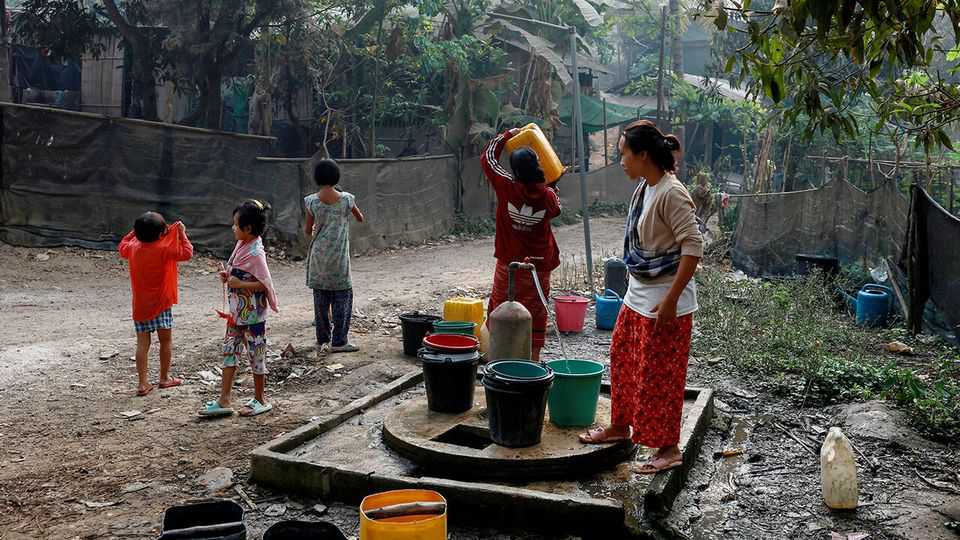
WITHIN ONE month of USAID being dismantled last year, the Pyi Gyi Khin organisation in Myanmar laid off 14 of its most experienced staff, people who had spent years building trust with people living with HIV. Then came a devastating earthquake in March 2025 that destroyed the cold-chain storage used for medications. Staff watched life-saving drugs spoil in the heat. “We undid 20 years of public-health progress in a single year,” says Naw Zarli, the group’s project co-ordinator. The organisation’s budget has been slashed by 80%. It has found no replacement funding.
After the gutting of USAID, some speculated that China would step into the breach. After all, when the earthquake hit Myanmar, China sent a large rescue operation and pledged $142m in support—something America would have previously done. But the idea that Chinese development finance can substitute for what has been lost misunderstands both what disappeared and what China actually offers.
China’s foreign-aid budget—around $2.8bn in 2024—is a fraction of USAID’s pre-Trump spending of some $35bn that year. But the gap is structural even more than fiscal (see chart). Roughly 85% of China’s overseas financing is issued as loans rather than aid, according to AidData, a research lab that tracks Chinese development financing at William & Mary, a university in Virginia. Its official development assistance (ODA), which includes grants and concessional loans, was just 1.3% of its global portfolio in 2023. Its annual aid budget is roughly the size of Italy’s. For every dollar China donates, it lends 35. Before and after the USAID cuts, China’s strategy stayed the same: narrowly defined to pursue its economic and strategic interests.
Between 2014 and 2022, 63% of American aid went towards improving governance, and on health and humanitarian assistance, according to AidData. These programmes supported civil society, funded health clinics and trained independent journalists, including in countries where China’s influence is growing. China’s money flows overwhelmingly to industry, mining, energy and transport: big-ticket infrastructure projects built mostly by Chinese state-owned enterprises, financed through sovereign loans and designed to generate commercial returns. Donald Trump is now using the Development Finance Corporation to similar ends.
This mismatch means that the losses are most acute in precisely the areas China has no interest in replacing. Across South-East Asia, independent media outlets that relied on American funding are collapsing. In Myanmar, where America provided around 70% of funding for many outlets, several are expected to fold this year, says Rowan Reid of Internews, which trains journalists and was in part funded by USAID. Atrocities by the military junta—air strikes on villages, mass killings—will go increasingly unreported. “It works so well for the junta,” says Mr Reid. “If there’s no reporting, it just becomes one big blind spot.” After USAID funding dried up, Nyan Linn Htet, the founder of Mekong News, an independent outlet covering Myanmar, laid off 13 of his 15 permanent staff and shrank coverage. The closure of Radio Free Asia and Voice of America has in particular hit countries such as Cambodia, Laos, Myanmar and Vietnam, where autocrats have long attacked independent journalism. China, meanwhile, has been quietly expanding its media footprint. It offers content-sharing agreements to small newsrooms across South-East Asia and the Pacific Islands.
The health consequences are equally stark. Ms Zarli is witnessing a spike in new HIV infections as programmes shut down. For decades USAID provided aid to non-profit organisations that worked on public-health issues such as family planning, HIV, malaria and tuberculosis. China’s long-held principle, in contrast, has been that aid must bring “mutual benefits” to both the donor and recipient. Its health-related aid is focused on loans to governments to build infrastructure or given to multilateral organisations such as the United Nations that redistribute the funds.
In Cambodia, the human-rights organisation ADHOC—which provides legal aid to victims of land-grabbing, trafficking and sexual assault—has laid off more than 60% of its staff and shrunk operations from 23 to 12 provinces. USAID accounted for 70% of its budget. European donors have covered 10-15% of the shortfall. Chinese funding, says Ny Sokha, ADHOC’s president, is not an option. Even if China offered money, Mr Ny Sokha says he would not take it because China is undemocratic and does not respect human rights.
To be sure, China runs its own programmes that promote its model of governance and export its political ideology by training politicians, government officials and journalists from poor countries. But Mr Ny Sokha and his fellow human-rights activists are never invited to join. ■