Oscar Wilde’s grandson separates fact from fiction
Merlin Holland sets the record straight on the Irish writer’s life
“A FLYING ANGEL with an erection.” That is how Oscar Wilde’s son described the winged figure suspended in stone above his father’s tomb in Père Lachaise Cemetery, Paris. In the decades after the Irish writer’s death in 1900, the offending member grew smooth from the caresses of his admirers; in 1961 vandals knocked off the testicles. Fans took to leaving greasy lipstick kisses on the tomb instead, which required corrosive cleaning. Merlin Holland, Wilde’s grandson, spent years calling on French fonctionnaires to protect it. A glass panel went up in 2011.
The sticky tributes have an oddly symbolic quality, for Wilde’s reputation has also accrued fallacies and fabrications. Mr Holland, who is the literary executor of the Wilde estate, has spent 40 years trying to strip them away. “After Oscar” lays out everything that has been embellished in Wilde’s name by biographers, forgers, false memoirists and members of his own family. Mr Holland admits he wrote the book “with a modicum of anger, channelled into storytelling”.
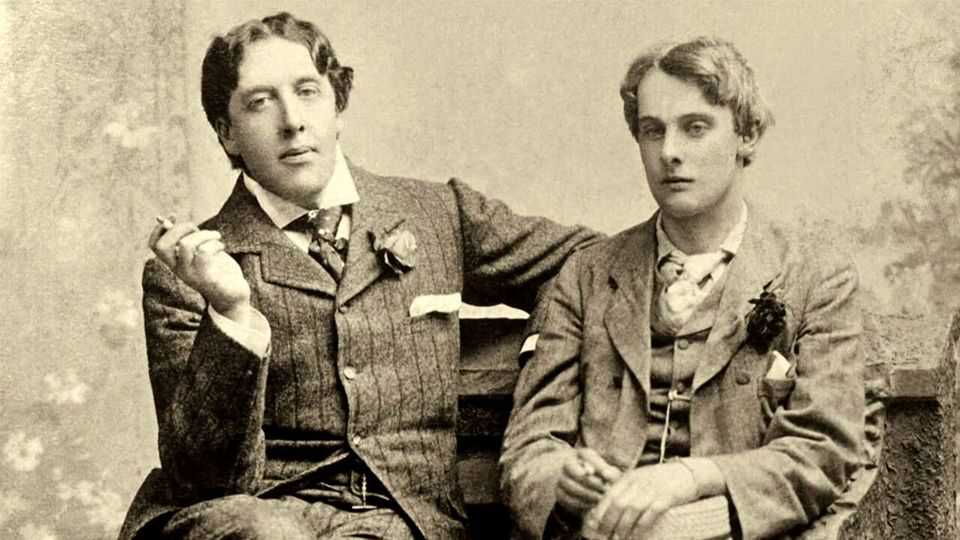
The book begins with Wilde’s release from prison in 1897. His fall had been swift. Just two years earlier, Wilde was the toast of London, with two plays on the West End. He was also openly in thrall to Lord Alfred Douglas, a young aristocrat. On the opening night of “The Importance of Being Earnest”, Douglas’s father brought a bouquet of rotting vegetables to throw at Wilde. Barred from entering, he prowled outside “chattering like a monstrous ape”, Wilde wrote. Later, he left a mispelled card at Wilde’s club calling him a “somdomite”.
Wilde sued for libel—a disastrous decision. The defence announced its intention to call as witnesses male prostitutes with whom Wilde had had sex, forcing Wilde to withdraw his suit. He was then arrested, tried for “gross indecency” and sentenced to two years’ hard labour. His wife, Constance, took their sons abroad and changed their name to Holland. “Such was the need”, Mr Holland writes, “to dissociate the family from anything that could connect it with Oscar Wilde.”
After his release, Wilde travelled to France, hoping to be reunited with his family. Constance’s friends and relatives kept them apart. Polite society had no place for a convict and “unrepentant homosexual”. Wilde never saw his boys again. He died in Paris, penniless, at the age of 46.
It did not take long for what Mr Holland calls “follow my leader” biography to set in: one writer’s conjecture was adopted by the next, without scrutiny, until it hardened into fact. The most consequential example was the theory that Wilde had died of syphilis. First published in 1912, it was still being repeated in 1987 in a celebrated biography by Richard Ellmann. Doctors who reviewed Wilde’s records have since argued that he died of cerebral meningitis following an ear injury sustained in prison.
By the 1920s it had become fashionable to recall an intimate friendship with Wilde. A French poet claimed to have been his only friend in his final days in Paris—entirely ignoring the two loyal companions who had actually been at his deathbed. Forgeries appeared, too. In 2007 Mr Holland spotted fake Wilde manuscripts at an auction in San Francisco, recognising them as the work of a forger from the 1920s.
Mr Holland’s own family caused its share of distortion. His father Vyvyan wrote a memoir entitled “Son of Oscar Wilde”, which Mr Holland spent years fact-checking. He found that Vyvyan, unable to resist improving on a dimly remembered past, had adorned the truth in places. (Who was it that said “Lying, the telling of beautiful untrue things, is the proper aim of Art”?) Mr Holland’s mother Thelma went further, burning pages from Vyvyan’s diary and insisting that Wilde was “basically heterosexual”. Even as Wilde’s work was revived, the family’s shame persisted.
“After Oscar” is ostensibly a record of the vicissitudes of Wilde’s posthumous reputation. But it ends up being something much more interesting: an account of what happens to the people left living with a scandal they did not create. ■