Only one of Berkshire Hathaway and SoftBank can survive
The two represent competing visions of the future
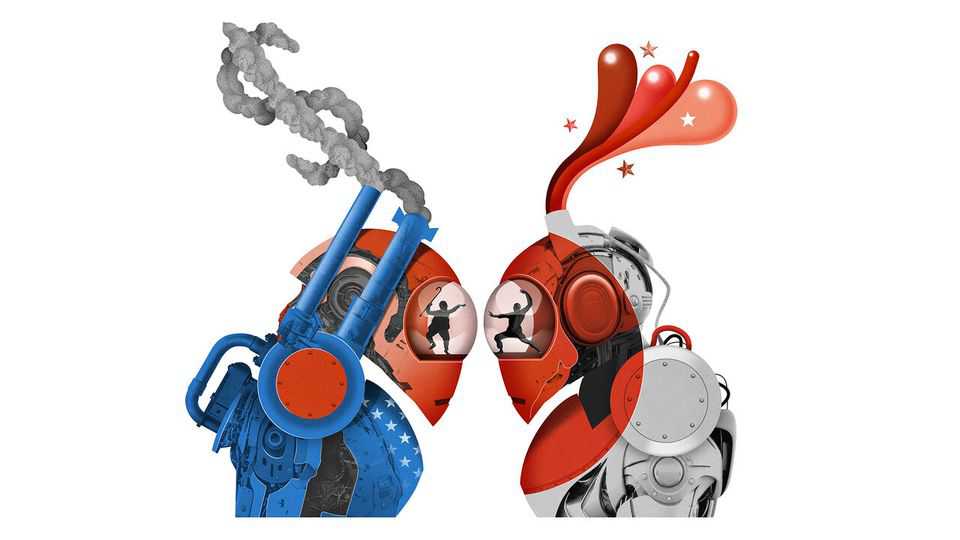
For two firms that embody opposite visions of capitalism, Berkshire Hathaway and SoftBank Group have a great deal in common. Both are an uncategorisable mix of operating conglomerate and investment fund. Both were built by singular men recognisable by their first names. And both receive little scrutiny from the bank analysts who write about them and the adoring investors who own their shares.
Each would also regard the other’s balance-sheet as an aberration. Berkshire under Warren Buffett, who recently retired as chief executive (though not as chairman), amassed nearly $400bn of cash. It has little idea what to spend it on. Only a crash comparable to that of 1929, 1987 or 2008 would vindicate this sober inaction. SoftBank, by contrast, has an excess of ideas courtesy of Masayoshi Son, its futuristic founder, but little cash. No sooner does the firm borrow money than it flies out of the door to finance the artificial-intelligence gold rush under way in Silicon Valley. For Mr Son’s heavily indebted firm, a crash could be terminal.
The pair are a kind of yin and yang: what repels Berkshire delights SoftBank. During the dot-com bubble Mr Buffett, who aims to buy companies with unassailable “moats” at cheap prices, stuck, in his words, to “such cutting-edge industries as brick, carpet, insulation and paint”. Meanwhile Mr Son, who likes high-tech companies whatever their price, was making his name investing in Yahoo, an American internet firm, and Alibaba, a Chinese one. Two decades later Mr Buffett was again saving up for the bargains that might emerge after a market correction, just as Mr Son was docked in the Bay Area spending his massive “Vision Fund” like a sailor on shore-leave.
Both firms have come to resemble parodies of themselves. Berkshire’s cash pile is now worth an astonishing 40% of its market capitalisation, double its average over the past two decades. In recent years it has bought back almost none of its own shares, presumably because it thinks they are overvalued, and it has not paid a dividend since 1967. Berkshire mostly ignores what’s going on in Silicon Valley, where its largest holding is in Apple, a rare tech giant not spending the entirety of its cashflow building data centres. The result has been underperformance. Greg Abel, Mr Buffett’s successor as chief executive, delivered his first sermon to Berkshire shareholders on May 2nd. During the past year their shares have undershot the market by 40 percentage points (about as much as they did in 1999).
For its part, SoftBank lost a fortune on startups whose value was inflated by central banks’ easy-money era: it was, notoriously, the largest investor in WeWork. But that has been more than offset by its bet on Arm, a British chip designer it bought for $31bn in 2016 that is now worth $250bn (SoftBank owns 87%; the rest is listed on the Nasdaq). Mr Son’s new big wager is on OpenAI. By October SoftBank, which is OpenAI’s second-largest external shareholder after Microsoft, will have invested $65bn in the maker of ChatGPT. It has committed to spend $3bn annually on OpenAI’s products, contributing perhaps 10% of the AI lab’s revenue. This year it will also pay $5bn for the robotics arm of ABB, a Swiss engineering firm, and $4bn for DigitalBridge, a data-centre business.
Quite how Mr Son will settle these bills puzzles some lenders and frightens others. The cost to insure against a default on its debts has soared. Cashflows from its operating businesses are insufficient. Selling assets would help. But having hawked the family silver (SoftBank sold the last of its Nvidia stock in October), it must now strip metal from the roof of its rusty garage. Its shareholdings in T-Mobile, a telecoms company, Grab, a food-delivery firm, and DiDi, a Chinese ride-hailing platform, are worth much less than they were even a year ago. According to the Financial Times, SoftBank is also considering yet another stockmarket listing, this time made up of an undefined grab bag of loosely AI-related businesses.
The most likely answer is more debt. But from where? The firm already faces a steep wall of maturities: the $40bn bridge loan SoftBank took out to invest in OpenAI matures next March. Selling bonds to Japanese retail investors costs more than it used to. The firm says its level of debt is copacetic, but the “loan-to-value” figure it telegraphs is something of a fantasy, since it ignores an additional $28bn borrowed against stock SoftBank owns in Arm and its Japanese telecoms operation. (The firm is also after a further $10bn to be borrowed against its stake in OpenAI.)
Berkshire and SoftBank are refugees in each other’s countries. These days Berkshire is most active in Japan, where it has accumulated a portfolio worth $45bn. It joins a caravan of American activist and value investors who have fled a market they view as expensive and concentrated. SoftBank, which has bet the house on Silicon Valley, is heir to a risk-loving tradition that runs in the opposite direction. Japanese banks have always tried to muscle in on Wall Street; the best American leather jackets are made in Japan.
Only one of the firms’ gambles can pay off. If it is Berkshire that comes undone, the process will be slow. For now, Mr Abel is protected by Mr Buffett’s voting power. But an uncomfortable truth is that the only thing harder than building a business like Berkshire is bequeathing one. If the market keeps rising, as it has for years, Mr Abel must eventually return Berkshire’s mountain of cash as a dividend or break up the firm entirely. The dissolution of SoftBank, by contrast, would be a spectacle. If the value of Arm were to collapse, or OpenAI fails to list its shares, as seems increasingly likely, Mr Son’s firm will struggle to pay back its debts. Excessive temperance and risk-taking are permanent features of free markets; the firms that best embody them are not. ■