Narendra Modi has extended his grip on India
India’s ruling party scores a historic victory in West Bengal—but should beware voters’ unhappiness with incumbents
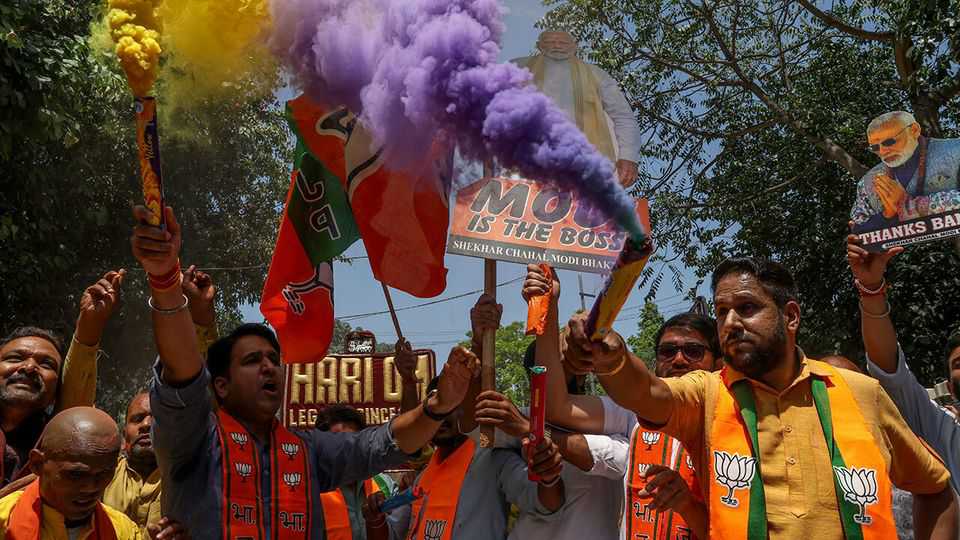
SIX WEEKS ago Narendra Modi stood on a temple-like stage in Kolkata, before a sea of saffron-clad voters. The event marked the beginning of his party’s campaign to win the populous and important state of West Bengal, one of five states that voted over the past few weeks in elections whose results were announced on May 4th. India’s prime minister, a Hindu-nationalist strongman, was in a typically pugilistic mood. He accused party members from Mamata Banerjee’s Trinamool Congress (TMC) of taking “cut money” and conspiring in “infiltration” from neighbouring Bangladesh. “Every single one will be made to pay,” he told the cheering crowd.
Bengalis will now get to see what he meant. Mr Modi’s Bharatiya Janata Party (BJP) won a landslide in the eastern state, in one of its most important victories since it came to power nationally 12 years ago. Even as incumbents elsewhere struggled, the BJP also won a third term, with 37.8% of the vote, in neighbouring Assam (see map). Nor was Ms Banerjee the only once-mighty regional leader booted out. In the southern state of Tamil Nadu, M.K. Stalin was ejected. In neighbouring Kerala, the incumbent Communists were also kicked out by voters.
Controversy has swirled over the way the elections were run. Mr Modi is not the first Indian leader to use his power over institutions to tilt elections in his favour. But he is perhaps the most ruthless in doing so since Indira Gandhi cancelled them altogether in the 1970s. His latest tool, wielded most aggressively in West Bengal, is the revision of electoral rolls that, say critics, left millions unable to vote. Yet as concerning as such methods are, they cannot explain Mr Modi’s dominance, which depends on his ability to unify Hindu voters. His coalition now runs 22 of the 31 states and territories with elected legislatures.
The BJP had already begun to march eastwards from its Hindi-speaking heartlands, winning Tripura in 2018 and Odisha in 2024. But West Bengal was the prize it had long wanted. The state has a rich history, notably as a hotbed of nationalist politics. Kolkata, its capital, is one of the great Indian cities. The state’s main attraction, however, is its size: with a population of 100m and some 42 seats in the Lok Sabha, the national parliament, it carries great electoral clout. Assuming the BJP suffers some attrition in its heartlands in the coming years, says Milan Vaishnav of the Carnegie Endowment, a think-tank, a foothold in West Bengal provides the party with some insurance.
The scale of its victory—it won over 45% of the vote and more than two-thirds of seats in the state—indicates how many Bengalis were fed up after 15 years of TMC rule. Under Ms Banerjee, industries moved out and the state’s economy fell behind that of much of the rest of the country. Voters had come to see her party as authoritarian and corrupt; the BJP focused on a teacher-recruitment scandal, while vowing to bring investment and to match Ms Banerjee’s promises of freebies. It did particularly well among urban, middle-class voters. And it won a large portion of the Hindu vote, making the electorate in West Bengal one of the most religiously polarised of any state in India.
Even if the way the election was conducted did not sway the result, it is concerning. More than 9m names, 11% of the electorate, were removed from the electoral roll. Disproportionately these were Muslims, women and Dalits who make up the TMC’s base. The BJP argues that such an apparent bias was inevitable because Ms Banerjee had fiddled the lists. Yet the rushed process, overseen by an electoral regulator that critics say is increasingly under Mr Modi’s thumb, hardly instilled confidence that all was fair. Of 3.4m voters who appealed against exclusion, fewer than 2,000 appear to have been reinstated in time to vote. The BJP-run central government also bused in almost a quarter of a million armed police to oversee voting. There were reports of election officials intimidating TMC candidates and voters. Since the election there has also been violence on both sides.
Elsewhere in the country things were less heated, but incumbents similarly struggled with voters unhappy about rising prices and poor governance. In Kerala the ruling Communist government was replaced by a Congress Party-led coalition. That was no great surprise, given that Keralites have tended to swap between two main parties at almost every election, though it does mean that India has no Communist state-level government for the first time in almost 50 years. More of a shock were the events in Tamil Nadu, with the loss of Mr Stalin to Vijay, a Tamil cinema megastar turned politician.
Mr Stalin had long been a leading figure in the Congress-led national opposition alliance and a chief proponent of Tamil-identity politics, in opposition to Mr Modi. He helped make his state an industrial powerhouse, attracting the likes of Apple and Ford with pro-business reforms. Yet like Ms Banerjee, he also came to be seen by many voters as corrupt, though both of them deny the charge. Vijay’s victory was driven by young urban voters with little love for the old guard, says Rahul Verma of Shiv Nadar University in Chennai. Analysts have been left scratching their heads about how the political novice, at the head of a two-year-old party, will govern one of India’s most dynamic states.
On the face of it the elections leave Mr Modi’s ruling coalition more dominant than ever, and his opponents in disarray. Since suffering a setback at the national election in 2024 (he won, but is obliged to rely on coalition allies), he has now notched up a string of state-election victories. He may conclude that there is more mileage yet in his brand of strident, communal politics—and in pushing the limits of his powers. Yet the results contained another message: that many Indian voters are unhappy with incumbents. As a result, they may prove to be volatile. And that is before they have fully felt the pain of rising prices as a result of the energy crisis triggered by war in the Gulf. (Once voting concluded, the central government said that cooking-gas prices would be raised.) If Mr Modi’s opponents can get their act together, they have just been given an opening. ■