Friedrich Merz can’t go on like this
His one-year-old government looks exhausted, and voters are tiring rapidly
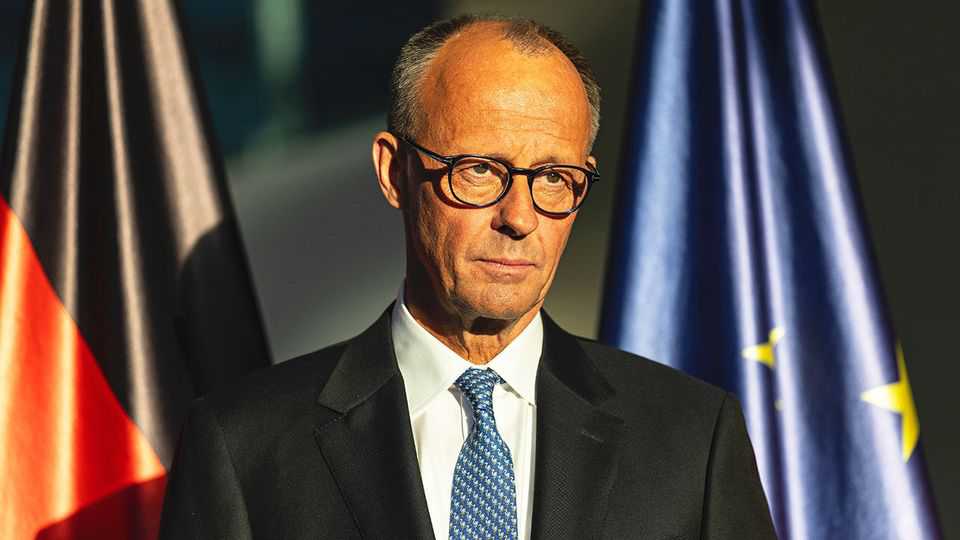
IT IS A sunny spring morning in Salzwedel, a picturesque town of half-timbered houses and cobbled streets in the east German state of Saxony-Anhalt, and people have come to shout at Friedrich Merz. Outside the cultural centre where Germany’s chancellor has agreed to take questions from locals, farmers and others protest against his energy policies. Inside, a skin-cancer victim upset about proposed changes to screening rules complains that politicians feather their nests as ordinary folk suffer. “The chancellor only talks around the issues, he offers nothing concrete,” says Thomas Becker, an entrepreneur angry about red tape and aid to Ukraine. He wants new elections.
Mr Merz, who took office a year ago, is not without achievement. Even before becoming chancellor he pushed through constitutional changes to enable massive investments in rearmament and infrastructure. Mr Merz’s coalition—which unites his centre-right Christian Democrats (cdu) and their Bavarian sister party, the Christian Social Union (csu), with the Social Democrats (spd)—has approved reforms to welfare, tax, energy and, most recently, health care. The sting has been drawn from a bitter debate over irregular migration as numbers have tumbled (albeit largely due to events outside the government’s control). And notwithstanding his recent spat with Donald Trump , Mr Merz has restored a sense of vitality to German foreign and security policy.
Yet, as the event in Salzwedel suggests, Germans are fed up with the chancellor. Although Mr Merz never commanded Germans’ affection, now just 13% say they are satisfied with his work and only 11% think his government is doing a good job. The cdu/csu has slid in polls to just 23% since winning last year’s federal election with 29%. The SPD is in even worse shape; it was hammered in two recent state elections and languishes on 13%.
Meanwhile, the populist-right Alternative for Germany (afd) has opened a polling lead (see chart), despite endless scandals and squabbles. It hopes to take power for the first time when Saxony-Anhalt votes in September. Mr Merz still talks a good game, relishing his self-appointed role as a teller of unvarnished truths to a struggling country loth to accept change. But with three years of his term to run, he cuts an ever-lonelier figure. As he admitted this week: “The crisis narrative has taken on a life of its own.”
What has gone wrong? Mr Merz’s well-documented flaws—failure to grasp detail, a short temper and a tendency to speak before thinking—do not help. (He ticked off his ill critic in Salzwedel rather than sympathise with her.) A deeper problem is his shaky grip on the political machinery he oversees. The chancellery is disorganised and badly co-ordinated with cdu/csu mps. Lars Klingbeil, the vice-chancellor and spd co-leader, enjoys a decent rapport with Mr Merz but struggles with his own rank-and-file. Politicians’ speeches may hit the right note, but fail to become policy. Big promises, such as last year’s “autumn of reforms”, fizzle. A pall of exhaustion hangs over the government.
mps from the governing parties tend to offer more-in-sorrow-than-anger laments about their partners’ failings. There is something to this. spd lawmakers have cried foul over minor changes to social-security rules. Last year a caucus of young cdu/csu die-hards threatened to torpedo a pension change they said was unaffordable. The government’s slim majority of just 12 makes it easy for renegade mps to exert outsize influence. Isabel Cademartori, an spd mp, describes a “baffling disconnect in perception” whereby both governing parties believe their respective leaders have surrendered everything to the other lot, limiting space for the compromises needed to oil a coalition’s wheels.
This is partly because governing has become a grim drumbeat of cuts, crisis management and painful reforms. The government recently halved its economic-growth projection for 2026 to just 0.5%, owing, in part, to the blockage of the Strait of Hormuz, but also the sluggish pace of domestic reforms. Germans, as Mr Merz often notes, work fewer hours than those in almost any other country in the oecd, a club of mainly rich countries. Ballooning social-security costs and high marginal tax rates are hardly incentives to work harder. And German industry is buckling under the twin assaults of American protectionism and Chinese mercantilism. “The real problem is that we can’t say that things will be better in three to four months,” says Reinhard Brandl, a csu mp.
Troublingly, bigger battles lie ahead. The governing parties are scrapping over how to fund a proposed tax cut for low- and middle-earners. Bar defence, almost every ministry must slash spending before next year’s budget is finalised. The biggest drama, predict insiders, will be over the public-pension system, which gobbles up a quarter of the federal budget. After an official commission reports in late June, the government will have to find a way to trim €4bn ($4.7bn) from its pension bill, and battle lines are being drawn up. “The reform debate suffers from one big defect: this country needs a vision but doesn’t have one,” says Stefan Kolev, the head of the Ludwig Erhard Forum, a think-tank.
So grim is the mood that Mr Merz has had to push back hard against the growing number in his ranks who want to blow up the coalition, either by calling an early election or governing alone with ad hoc majorities. That is unlikely, since in both cases the biggest beneficiaries would be the afd. And optimists may yet be found. “When we do our job properly, our support will rise again,” insists Mr Brandl—perhaps more in hope than expectation. ■