Europe is unshackling business. But not enough
Why market liberals must win the battle for Brussels—and national capitals, too
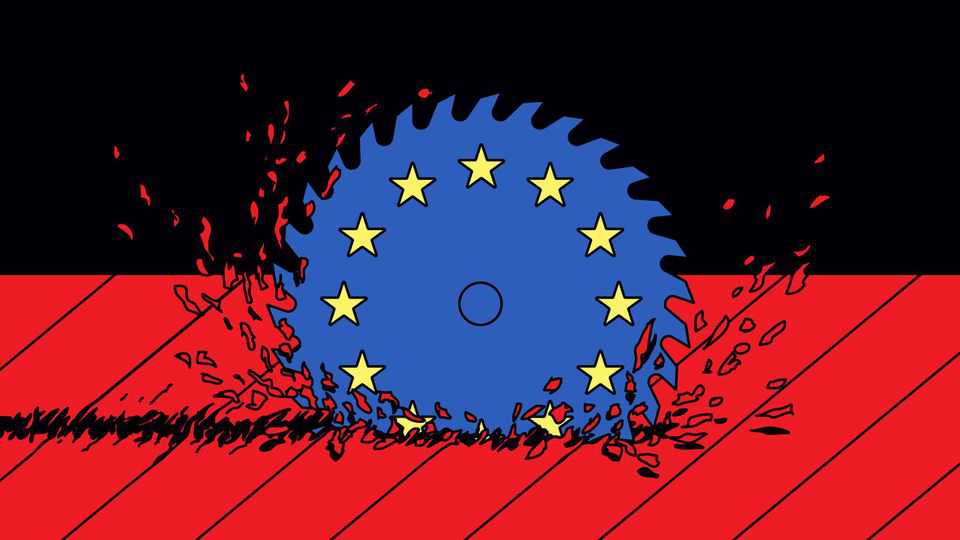
Everyone knows that the European Union’s economy is weighed down by regulation. But you may not have spotted that everyone now includes Europeans themselves. They are so rattled that the momentum to fix the problem is the greatest in a generation. On April 28th the eu unveiled plans for its rule-making to be simpler and more consistent. It gave a timeline for accomplishing this, and for removing barriers to trade within the bloc. The trillion-euro question is whether, after many false starts, Europe can at last turn its good intentions into progress.
Europe needs to grow if it is to pay its debts, care for its swelling legions of elderly citizens and defend itself without America’s help. Yet its economy is far behind that of Uncle Sam. In the first quarter its output barely grew—and now the Iran war has driven up energy prices.
The battle for growth is being fought on two fronts. The first is in Brussels, where two very different strategies vie for favour. Some eurocrats think the eu should pivot to subsidies, protectionism and Chinese-style state capitalism. Others prefer the liberal route of more open, competitive and integrated markets.
In recent years the EU’s economic thinking has acquired a more French flavour: somewhat warier of competitive markets and free trade, more in favour of dirigisme. Encouragingly, however, some more liberal attitudes are holding their own. Proposed changes to the EU’s strict merger guidelines once seemed likely to water down the bloc’s traditional devotion to consumer welfare so that “European champions” might emerge. Now it looks as if the rules will be tweaked rather than overhauled. Europe’s commitment to competiton survives.
Still, it is one thing to avoid backsliding. What about progress? As well as the deregulatory push, which includes ten “omnibus” bills aimed at reducing companies’ administrative costs, trade continues to be liberalised. On May 1st a pact between the EU and Mercosur—whose full members are Argentina, Brazil, Paraguay and Uruguay—provisionally came into effect. New agreements have also been struck with India, Indonesia and Australia, and pacts with Malaysia and the Philippines are in the offing. Unlike President Donald Trump’s often superficial and fragile trade deals, these ones are deep and the product of years of work.
The second fight is at the national level and will be harder to win. Much rule-making power sits with national governments, which love to blame Brussels for their own red tape. They often choose to protect domestic firms, especially from foreign competition in services. They also make the eu’s rules more burdensome when writing them into domestic law. Politicians are under constant pressure from protectionists who resist everything from connecting up electricity grids to letting firms registered in one country operate in another.
Reforms at the national level are slow. Each government is one of 27. Too few share Brussels’ new sense of urgency. Many are loth to take on vested interests, hoping to reap the benefits of reform in other countries without having to pay a political price themselves. With recent changes, such as with Denmark’s postal service or Dutch pensions, the action has mostly been in market-friendly places. Countries bogged down with rules, such as Italy and Germany, have done too little.
Boosting European growth requires national governments to join the liberalising effort. It also means implementing many of the other recommendations set out in the dossiers penned by Enrico Letta and Mario Draghi, two former Italian prime ministers. Europe’s startups need more capital, which might be provided by adequately funding pension schemes while continuing to integrate capital markets across borders. The continent must attract more of the world’s most talented workers, with bloc-wide visa schemes and by recognising foreign qualifications. And it needs cheaper energy, which requires investment in its grid and the careful design of markets as more renewable power comes online.
None of this will be easy. The eu has endless counterproductive regulations. Attempts to get rid of them often fail, not least because reactionaries on the left and right defend them. But Europe is also a huge economy of 450m people, with nearly a fifth of global output. Will the wealth of that prize and the dire consequences of failure make this time different? More than ever, Europeans need to simplify and deregulate. ■