Will Kevin Warsh Trumpify the Federal Reserve?
The incoming Fed chair says he wants regime change. But a revolution is unlikely
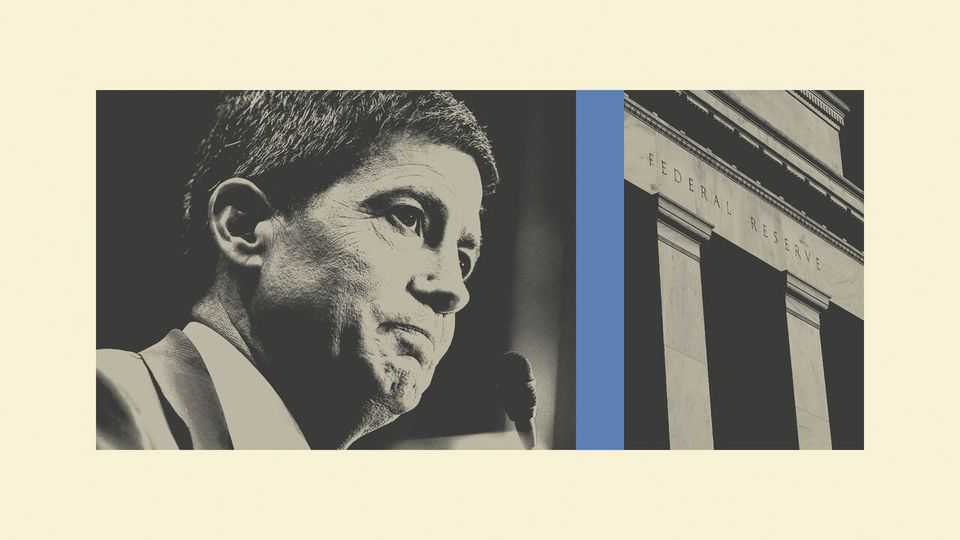
POLITICIANS TEND to let America’s central bank be. Few voters pay direct attention to monetary policy, and when they notice inflation, it can be helpful to have someone else to blame. Donald Trump is not a usual politician. In his second term the president, who believes interest rates are too high, has assailed the Federal Reserve with angry lawsuits, fulminated on social media about its chair, Jerome “too late” Powell, and launched a bogus criminal probe into Mr Powell to browbeat him.
So far presidential haranguing has not had the desired effect. It may even have backfired, by stiffening the spines of the Fed’s defenders. The Supreme Court looks poised to deny Mr Trump the right to fire Lisa Cook, a Fed governor. A ploy by Thom Tillis, a retiring Republican senator, to hold up the confirmation of Kevin Warsh, Mr Trump’s pick to succeed Mr Powell, succeeded in forcing the Department of Justice (DoJ) to drop its case against the Fed chair on April 24th. Markets now shrug off Mr Trump’s regular Fed-bashing.
Could Mr Warsh, whose path to the top job has been cleared by the DoJ’s climbdown, reshape the Fed in a Trumpier mould? He certainly comes across as more pliable than his steadfast predecessor. He secured the nomination by abandoning a lifetime of inflation hawkishness and aligning his position with the dove-in-chief at the White House. In his mostly dull Senate confirmation hearing he passed the MAGA purity test by refusing to say outright that Mr Trump lost the 2020 election to Joe Biden. And he has, in what is “YMCA” to Mr Trump’s ears, called for a “regime change” at the central bank.
However, a closer look at what Mr Warsh wants to do at the Fed—and what he can realistically achieve—hints at a much more modest project. That is because his ideas are either marginal, irrelevant or beyond the power of a Fed chair alone to bring about.
Start with what Mr Warsh is not planning to do. Fed insiders have worried that the regime he wants to change is literally the Fed’s personnel. The main fear was that he would try to sack the presidents of the regional branches, five of whom vote on monetary policy, and replace them with Trump toadies. Many minds were put at ease when he appeared to rule this out in the Senate hearing. When asked directly whether “regime change” amounted to a purge of branch presidents, Mr Warsh said: “I meant policy regime change”.
That is reassuring. For when it comes to policy, Mr Warsh is often a marginal revolutionary. He often gets most exercised by the smallest of details. One of his biggest bugbears is rate-setters paying too much attention to “core” inflation, which excludes only volatile food and fuel prices, and too little to “trimmed-mean” measures, which drop any prices that have risen or sunk the most. Trimmed-mean inflation can be lower than the core measure and so justify lower rates. But most of the time, including now, the two are almost indistinguishable (see chart 1).
Other of Mr Warsh’s most cherished ideas would make similarly little difference in practice because they are out of date. He wants to get monetary policymaking out of politically charged terrain such as climate change and social justice. The Fed has, sensibly, done this already. He is wary of expansive readings of the central bank’s mandate to promote employment, which during the covid-19 pandemic may have undercut its other job of maintaining price stability. The Fed has already closed the book on those, too.
Mr Warsh has essentially two substantive ideas for meaningful reform. One is his desire to trim the Fed’s balance-sheet in short order. Many observers agree that, at $7trn, it is bloated. Although Mr Warsh has signalled he does not favour shrinking the central bank’s bond holdings at breakneck pace, any movement in that direction goes directly against the Fed’s recent decision to end “quantitative tightening”, where the balance-sheet shrinks gradually by letting those holdings mature. The effect of bond sales could be to lower their prices and, since the two move inversely, push up yields. To offset the rising yields, which determine other interest rates in the economy such as the ones for mortgages, Mr Warsh would cut short-term rates. But since the effect of the Fed’s bond sales on yields is uncertain, the exercise could blow up if not handled deftly.
The second of Mr Warsh’s big ideas is scepticism of “forward guidance”. Setting out a future path of monetary policy has been the norm at the world’s central banks since the global financial crisis of 2007-09. It is a way to signal intentions to the market, which is less volatile when not caught off guard. Forward guidance also helps shape long-term borrowing costs, which central banks do not set directly. Mr Warsh frets the practice does more harm than good by making policymakers dig in their heels and ignore new information that proves them wrong. Most Fed-watchers think the trade-off is worth it.
Scrapping forward guidance and rapidly shrinking the balance-sheet would be meaningful changes for the Fed. They are not, though, in Mr Warsh’s individual gift. Most relevant decisions require a majority of the seven-member board of governors. In both cases Mr Warsh will, as chair, have the bully pulpit but still cast only one vote. He will have to persuade the others to go along with his proposals, which might, accordingly, moderate.
He is no less constrained when it comes to the regular business of setting short-term interest rates. Rate-setting decisions need the support of at least seven of the 12 voting members of the Federal Open Market Committee (FOMC). Before the war with Iran, the market assumed several rate cuts this year. Now the conflict is pushing up energy and food prices, which could spill over into broader inflation. As a result, the expectation is for the FOMC to hold rates steady at 3.5-3.75% (see chart 2).
Mr Warsh’s arrival may not alter the voting balance of the fomc. Stephen Miran, a fellow Trump-approved rate-cutter, will vacate his position on the Fed board to make room for the new chair. Mr Powell, who was appointed to the board by Barack Obama but made chair by Mr Trump in 2018, said on April 29th that he would stay on as a governor after handing over the top job. He can stick around until 2028. The three incumbents appointed by Mr Biden are unlikely to go anywhere lest Mr Trump appoint lackeys in their place.
Both in the case of Mr Powell and of the Biden appointees, staying put is a break from convention. Few governors serve out their full terms. No recent chair remained after their term at the top expired. Given Mr Trump’s penchant for meddling, it is “critically important” that they all stay, says a former Fed official. Yet the president is a long way from a Fed majority. Even his two appointees from his first term, Christopher Waller and Michelle Bowman, are serious policymakers who are unlikely to consent to any MAGA monetary madness.
The constraints on Mr Warsh make it unlikely that he will radically transform the Fed. But this does not make him harmless. That is because, as Peter Conti-Brown, a Fed historian at the Wharton School of the University of Pennsylvania, points out, he and those closest to him “are taking way too seriously the false notion that the Fed is in crisis”.
Mr Warsh himself has, like many of Mr Trump’s cabinet secretaries, developed a habit of getting carried away when criticising the institution he is about to lead. In the past year he has called the broad conduct of monetary policy “broken for quite a long time”. If in office Mr Warsh cannot deliver what Mr Trump wants, blaming his colleagues may be a way to keep the president from turning on him. But having both a president and a sitting Fed chair fulminating against monetary policy would be unprecedented, and would worsen the politicisation of America’s central bank. ■