What really happened during the Black Death
A new book offers a different account of the pestilence
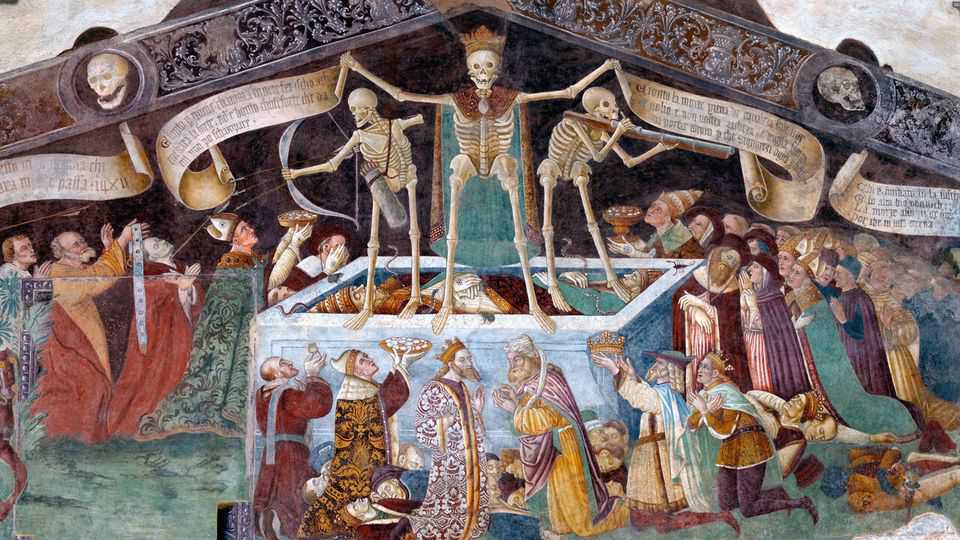
The disease seems to have emerged in Asia. It soon reached Europe, ravaging Italy first. It killed millions, often quickly. Many people perished at home, or died within a few hours or days of receiving medical treatment. So large was the death toll and so great was the danger of contagion that funerary customs were disrupted. People fled cities. All this was true of covid-19. It was also true of the Black Death.
As Thomas Asbridge describes in detail, the medieval plague was much deadlier. Many towns and cities lost almost half their inhabitants in the first wave of the disease, in the mid-14th century; subsequent waves were smaller but nonetheless terrifying. In Damascus a poet observed that “The plague sat like a king on a throne.” One English village was hit so hard that it did not recover its pre-plague population until the 19th century.
Although medieval people were used to sudden death, the plague devastated them. “I am overwhelmed, I can’t go on,” wrote Gabriele de’ Mussis, an Italian chronicler who lived through the first wave. A Byzantine woman, seeming only half alive herself, stared at her sisters’ graves and wept. The Black Death spurred pogroms, as Christians claimed that Jews were spreading disease by poisoning the water supply (during the attacks they made sure to destroy records of debts they owed).
But the disease also changed society and art, frequently for the better. The most enjoyable sections of “The Black Death” describe how some people did well out of the pandemic. In Cairo, gravediggers raised their fees. There was a boom in religious art in Italy, because so many plague victims left money for paintings in their wills. Venetian citizenship became easier to obtain. In 1349, as the plague carried away English clergymen, a bishop advised that the dying could make their final confession to a layperson—“even to a woman”.
A pestilence that was assumed to have been sent by God disrupted and intensified religious life. Russians built timber churches in a single day to show their piety. A new group, the flagellants, publicly lashed their bodies with whips. Perhaps the pandemic encouraged anti-clericalism and even prepared the ground for Martin Luther, Mr Asbridge suggests. He does not push that point too far, which seems wise, given the 170-year gap between the outbreak of plague and the 95 theses.
“The Black Death” draws on a wide range of sources, from administrative records to wills and diaries. It contains many portraits of people who lived through the plague. Several of these portraits could be shorter—indeed, the book could be shorter, as it occasionally goes into numbing detail—but some are wonderful. Best of all is the description of Alexandre Yersin, a headstrong scientist who rushed to Hong Kong during a plague outbreak in 1894. He was the first to identify the bacterium, which is named after him: Yersinia pestis.
The book makes two big claims, and amply proves both of them. Mr Asbridge, a historian of the Crusades, shows that the plague affected the Islamic world at least as profoundly as Christian Europe. Cairo may have suffered more than any other city. Some Islamic scholars reiterated the orthodox view that the disease was not contagious and that people must not on any account flee infected places. Many Muslims seem to have ignored them. The Ottomans were especially pragmatic, which may help to explain how they increased their power and influence in the region.
Mr Asbridge’s second claim is subtler. Although medieval and early modern people harboured theories about the plague that strike modern readers as ignorant, they tried their best, he argues. The authorities made broadly sensible decisions. Physicians risked and often lost their lives treating plague victims. That their treatments were rarely effective does not diminish their bravery (and one expensive Italian remedy, theriac, helpfully contained opium). In London plague victims were buried in mass graves, but neatly, with their feet pointing east.
People dealt bravely with covid-19, too. Yet the authorities made decisions, especially about restricting personal freedoms, that now strike many as appalling. The vaccines that have saved many lives and have allowed normal life to resume have given rise to conspiracy theories. Dealing with a germ that is far less lethal than Y. pestis has been hard and contentious. Modern people should think before they use the word “medieval” as an insult. ■