Margareta Magnusson believed in leaving the world tidy
The guru of decluttering died on March 12th, aged “between 80 and 100”
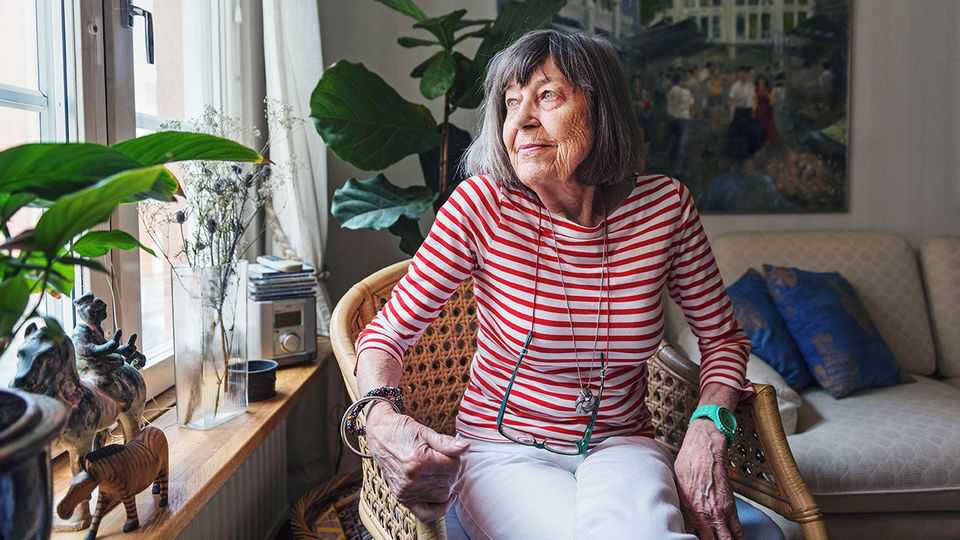
In recent years you might have seen her in the streets of Stockholm, a slightly bent old woman in a bright stripey top. She pushed a walker-stroller and wielded a grabber with which, neatly, she removed cigarette butts from the pavement. Each butt-removal gave her a small rush, like an absolution. As a heavy smoker for years, Margareta Magnusson was tidying up after herself.
That habit possessed her. Back at home she had nothing in the attic and, in the cellar, only an ancient bike. She had cleared out the cupboards in the hall, traditional resting place of unwearable old shoes. From the kitchen she had given away, among all sorts of other stuff, ten plates (why have 16, if your dining table seated only six?) and her infallible wok, which she had once worn as a hat to a fancy-dress party. Her two-bed flat held every piece of furniture she needed and no more, for she had plotted out their size and position on graph paper before she moved in. Any books remaining had already been picked over by family and friends. Clothes had been sorted into two brisk piles, Keep or Don’t Keep. Most were condemned. As for knick-knacks, they had to be either useful or full of meaning to be allowed to stay. Cushions and candles she still bought new, to be cosy, and a lot of chocolate—key to a joyous old age—was stowed around the place.
She kept life simple partly because she was tidy-minded, interrupting conversation to snip a cyclamen or rouse a storm among the books with her duster. Partly, too, reducing skräp in old age was traditional in Sweden, a clear-eyed and unsentimental place, where the Vikings had filled graves with the corpse’s clutter to get it out of the way. It was called döstädning, death-cleaning. Men could seldom do it, keeping even a rusty nail in case it might come in useful, but women could, and she was obsessive. Why leave all your accumulated crap for other people to deal with, typically your children, who had to take time off work to sort it out? It was your moral duty, before you died, to slim it down. It was also your duty to the planet, before you left it. Fired with this idea she wrote “The Gentle Art of Swedish Death-Cleaning” and in 2017, at 81, had a global bestseller on her hands.
Two Japanese, Marie Kondo and Nagisa Tatsumi, had beaten her to it, but she caught the imagination of the overstuffed West. She had plenty of experience, too. Her real career was as a painter and illustrator, in clean lines and bright colours, so she was used to giving treasured work to others. Over the years she had also moved 17 times within Sweden or abroad, following her husband’s work as a manager, eventually with five children in tow. This gave her a strong intolerance for packing, though it was not strong enough. Her vice was that she liked things. An important early lesson was that, to appreciate an object, you did not need to own it. Merely gazing at it in a shop window could be satisfying, too.
Most usefully, she had done three lots of delayed döstädning after the deaths of her mother, her mother-in-law and her husband Lars. The last coincided with her move from the big family house. Her mother had done pretty well, labelling everything to show where or to whom it should go, though she had also kept a secret stash of cigarettes in the linen cupboard. (Here was another argument for death-cleaning: do you really want your children to find the dildo in the drawer?) Her mother-in-law had already given away her Japanese silks and ceramics as presents, an excellent idea. From Lars’s packed-to-the-rafters man-cave she kept a hammer, pliers, a yardstick and a few screwdrivers, for usefulness. Young men from the neighbourhood were invited to take the rest.
Clearing up was often difficult, whether after death or before. Some objects were simply too hard to part with. The shells, for example, that she had gathered as a child from the beaches near Gothenburg, where she grew up. The falling-apart cookery book that held a chef’s handwritten recipe for fried herring and her neighbour’s for rosehip marmalade. A graceful wooden bird from Africa, the soft cotton baby clothes her mother had made. And the three stuffed animals, Ferdinam, Dear Bumbal and Old Bear, which had been around for ages, as live as pets. She kept them all, and her paints and brushes too.
The dining table, thank goodness, went to one of her sons, because she couldn’t bear to lose track of the games her children had played on it. If items like this were passed on, their stories had to go with them. Photos were the hardest to sift, but she sorted and distributed the best among her children, because these were the history of their lives. She also filled a box, not very large, with things that were valuable only to her—a stone, a letter, a dried flower—which was labelled “Private: Throw away”. Inevitably the children would look inside, but she didn’t mind, as long as her order was obeyed. Her readers should also have such a box.
Whatever she did not give to charity, or neighbours, or family, or throw out on the rubbish dump as far as she was able, was usually grist for her ever-hungry shredder. It was just a small one, but into it she fed all old bills, invoices and, after a moment down memory lane, no-longer-wanted photos and letters. Her readers were told to get one and enjoy it. To be rid of papers was to shed the bureaucratic weight of adult life. She could return to being the unfettered child who had spent her time climbing trees and fishing for crabs; and, freed of at least some human litter, the woods might shine as they used to back then.
This was the vital point about death-cleaning: it was not about death. It was about helping people to live more lightly in the present. Having shed the old stuff, they could look at the world with fresh eyes. Her second book, “The Swedish Art of Aging Exuberantly”, advocated lively curiosity as well as gin, laughter and Marabou bars. For herself, she started on a book called “Death-Cleaning from the Afterlife”. She didn’t really believe in that. But she did find it hard to credit that tidying up could, or should, ever stop. ■