LA’s levitating amoeba: a radically new kind of museum
Does ditching chronology and geography inspire or confuse visitors?
A HULKING structure hangs above traffic on Wilshire Boulevard like a levitating amoeba. The concrete-and-glass colossus—designed by Peter Zumthor, a Swiss architect—is known as the David Geffen Galleries and is the new home of the Los Angeles County Museum of Art (LACMA), the largest art museum in western America. After 20 years, the building will finally open to the public on May 4th. Its $724m price tag and daring architecture are not the only radical things about it.
“We’ve eschewed traditional categories of geography, chronology, medium,” says Michael Govan, LACMA’s director. “The idea is to wander.” Walk up the imposing concrete staircase and Mr Govan’s meaning becomes apparent. The museum’s single floor is a great equaliser: no one movement or era is presented as more important than another. Rather than galleries devoted to the usual suspects—the Renaissance, Impressionism, Surrealism—the museum is loosely organised around oceans and seas, as a way to emphasise trade and cultural exchange. The Indian Ocean section, for example, includes Turkish porcelain with blue-and-white floral patterns, influenced by earlier Chinese designs.
LACMA’s shunning of conventional organisation typifies a movement among some Western institutions towards less hierarchical, more global galleries. Christophe Cherix, the director of the Museum of Modern Art (MoMA) in New York City, reckons such experiments amount to “a generational shift” in how museums display their treasures.
In the 1990s and 2000s, while economies were globalising and liberalising, the art world was following suit. “We had a collection then that was almost an Enlightenment model based on the western European and North American canon,” recalls Frances Morris, a former director of the Tate Modern in London. “It was very clear to us that the big story of the next century would be to build a collection that represented the interconnectedness of culture.” When Tate Modern opened its permanent galleries in 2000, curators grouped art by theme, be it “nude” or “still life”. “The press hated it,” says Ms Morris.
After it expanded in 2019, MoMA rejected permanent exhibitions. “‘Starry Night’ will most probably always be on view,” says Mr Cherix of Vincent van Gogh’s much-loved painting. But, he muses, perhaps the adjacent wall will sometimes hold photography, rather than Rousseau or Cézanne.
In some ways, this approach mimics the Wunderkammern—cabinets of curiosities—of the Renaissance, when European rulers collected all manner of objects and displayed them in whichever way they pleased. Then and now, such an eclectic approach allows for serendipity. “The visitor’s hand isn’t being held in the usual way,” says Dan Hicks of Oxford University’s Pitt Rivers Museum. Yet it’s “a relative sort of chaos”, he admits, that not everyone may appreciate.
What is thoughtful contrast to one visitor is baffling incongruity to another. At LACMA a giant coffee table shows off ceramics from ancient Greece, modern America and much in between. Why? Visitors who scan tiny QR codes will find out; the rest will merely wonder. But if such experiments fail to impress, curators can reshuffle the art again. “I remember people finding the juxtaposition of a late Monet painting with a Richard Long mud-wall drawing very problematic,” remembers Ms Morris. “But then we showed Monet with Rothko, and people loved that.”
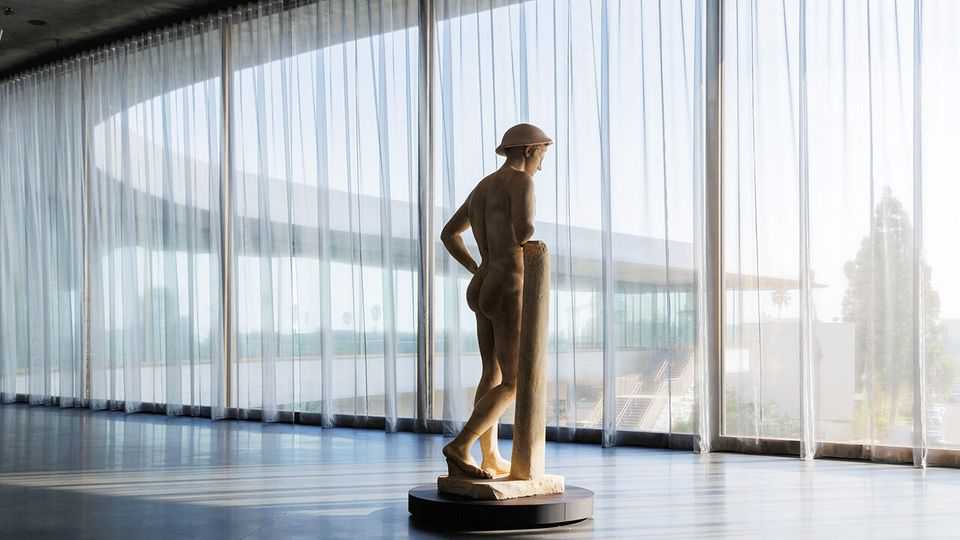
Museums should not be rigid, stuffy palaces for antiquities, many curators argue: they should reflect their surroundings and respond to their times. At the new LACMA, says Mr Zumthor, “We don’t go into a dark box and somebody tells us what to think.” Rather, the museum tries to be in conversation with Los Angeles. The way the amoeba wobbles over Wilshire seems an ode to California’s car culture—as does the inclusion of a Studebaker sports car, surrounded by photographs of highways and car parks. Architecturally, the museum’s floor-to-ceiling windows frame the palm trees and foothills in such a way that LA itself seems on display. ■