In “The Devil Wears Prada 2”, fashion magazines are off-trend
The sequel to the hit film is about the changing world of journalism
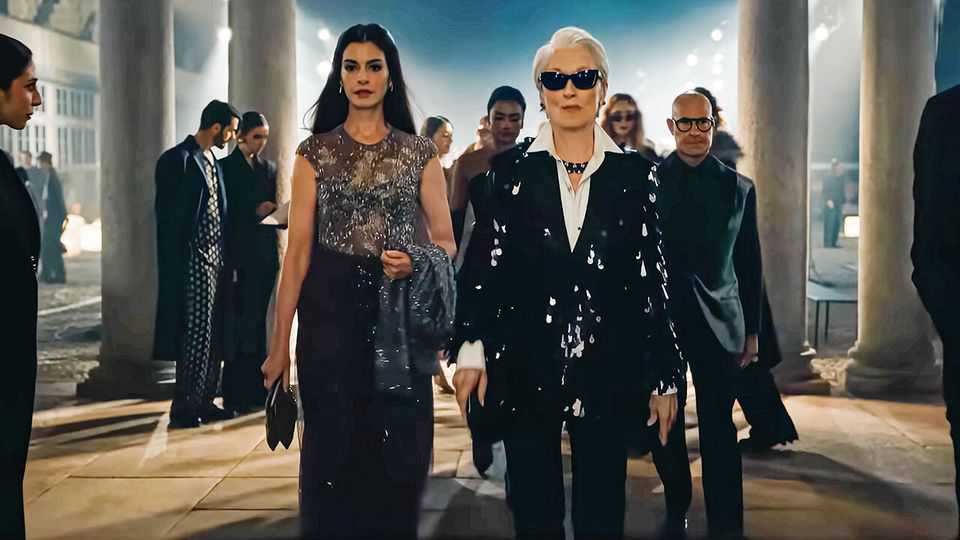
IT IS ONE of the most memorable monologues in 21st-century cinema. Miranda Priestly (Meryl Streep, pictured right), the formidable editor-in-chief of Runway magazine, is reviewing the latest dresses and accessories. Her ingénue assistant, Andy Sachs (Anne Hathaway, pictured left), scoffs when Miranda is asked to choose between two near-identical belts. So Miranda delivers a scathing takedown of everyone who believes the world of high fashion is frivolous and has no bearing on their personal taste.
Miranda traces how the precise shade of cerulean in Andy’s sweater was popularised in a runway collection years earlier, then picked up by other designers before making its way into department stores and, eventually, the “clearance bin” from which she assumes Andy acquired it. “That blue represents millions of dollars and countless jobs,” Miranda spits, “and it’s sort of comical how you think that you’ve made a choice that exempts you from the fashion industry when, in fact, you’re wearing a sweater that was selected for you by the people in this room.”
“The Devil Wears Prada”—a barely disguised fictionalisation of Anna Wintour’s reign at Vogue—was a smash when it was released in 2006. It depicted the glitz and glamour of fashion and sent up its culture of bullying and dieting. Twenty years on, Miranda’s withering lines (“Florals? For spring? Groundbreaking”) and signature dismissal (“That’s all”) still circulate as memes. The story has been adapted into a hit musical with music by Sir Elton John. And now Miranda, Andy and the Runway gang have returned for a sequel.
But anyone expecting more of the same may be disappointed. “The Devil Wears Prada 2”, it is true, boasts plenty of wonderful couture. But it is not all that interested in fashion’s contribution to culture and the economy. Instead, this time round, the focus is journalism. Characters rush around talking about budgets, buy-outs and advertising revenue—only they do so in Maison Margiela blazers and Valentino stilettos.
Andy left Runway at the end of the first film. At the start of the sequel, she is simultaneously being feted for her investigative journalism and being fired from her newspaper in a mass lay-off. (Among her greatest hits, supposedly, is a four-part series about the Federal Reserve.) Runway, meanwhile, is embroiled in a scandal, having run a glowing profile of a brand that uses sweatshop labour. The chairman of Elias-Clarke, Runway’s parent company, has the bright idea to bring Andy back in as features editor to help restore some credibility to the magazine’s journalism.
No sooner has she published the mea culpa than the chairman dies. His son—whose contempt for sartorial matters is symbolised by his gilet—decides that every Runway department will be cut back to the essentials. Anyone who has been working at the magazine for longer than five years is considered too expensive and will be laid off. Andy races to persuade a mercurial billionaire to buy Runway and thus save her career, the careers of her friends, and even the career of her still-harsh boss.
The problem is that the film does not persuade the viewer as to why Runway needs saving. In fact, the characters repeatedly talk about its increasing irrelevance in the social-media age. Miranda says the September issue is “so thin you could floss with it”. Nigel (Stanley Tucci), Miranda’s right-hand man, laments that Runway is no longer a tastemaker that hires photographers such as Richard Avedon. No one buys the physical product, he says, so instead the magazine produces “content that people scroll past” while they sit on the toilet. “Journalism still fucking matters,” Andy declares—but soon she is content to produce puff pieces at advertisers’ behest.
In the first film, the viewer shares Andy’s perspective. You smirk along with her when the two identical belts are produced—and then, like her, you feel chastened when you realise that Miranda is right, and no one makes aesthetic choices in a vacuum. But in the sequel no such moment of epiphany occurs. Neither Miranda nor Andy seems able to articulate why the magazine still matters. When the aforementioned mercurial billionaire starts talking about replacing models and photoshoots with AI, and Miranda offers up a toothless speech about how Runway celebrates beauty and human endeavour, you think: That’s all? ■