Hong Kong is a conduit for looted Chinese antiquities
The financial hub abounds with precious wares
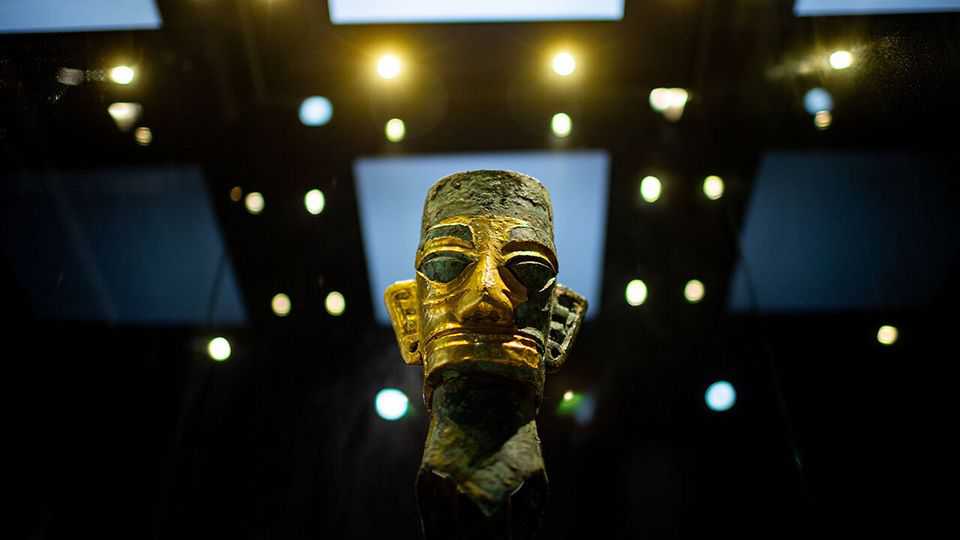
In the backroom of an unassuming antiques shop in Hong Kong, Gino Caspari discovered treasure. The Swiss archaeologist, who was posing as a buyer in order to investigate Hong Kong’s black market, knew about Sanxingdui masks (pictured): strange faces, heavy-lidded and thick-lipped, buried in sacrificial pits in south-west China 3,500 years ago. China’s government had designated some as “grade-one national treasures”, meaning they were subject to strict export controls.
So Mr Caspari was shocked when a dealer showed him what appeared to be a Sanxingdui mask hidden in the back of his shop. And this mask was exceptional: its eyes were filled in, unlike those on known pieces. Study of it could therefore make a real contribution to archaeology. (The eyes also suggested the mask was real: forgers tend to copy existing artefacts.) What was it doing in a shop in Hong Kong?
Since 2012 China has recovered more than 2,300 pieces through auctions and diplomacy. America alone has returned 600 smuggled cultural artefacts. Rich Chinese also started buying up such rarities as a way to demonstrate both prosperity and patriotism; prices for Chinese antiquities rocketed as a result. “Cultural relics and cultural heritage carry the genes and blood of the Chinese nation,” said Xi Jinping, the country’s leader, in 2022.
So it is surprising that Hong Kong, which reverted to Chinese rule in 1997, is “one of the main gateways for the illicit antiquity trade out of China”, says Steven Gallagher of the Chinese University of Hong Kong. China is party to both international conventions that target antiquities smuggling, and has stringent export controls. But Hong Kong is not. It has one law protecting archaeological objects, which applies only to those dug up there. No one has ever been prosecuted for the theft, looting or ownership of smuggled objects. Meanwhile Hong Kong’s status as a free port makes it an ideal transit point for such items, says Toby Bull, a former policeman now also at the Chinese University.
The territory is also one of the last places in the world (the Canadian province of British Columbia is another) where the legal principle of “market overt” still exists. Sometimes called “the thieves’ charter”, it is based on ancient English law and gives buyers “good title” to stolen objects if they are purchased in good faith from a shop or market that usually sells such wares (the common-law rule of ownership means a buyer cannot obtain “good title” to stolen goods bought from a thief). That can give dodgy goods a clean bill of health. As a result, the city has attracted illegal antiquities. Mr Caspari reckons that most of the objects in Hong Kong shops that are not forgeries have been stolen or looted. This means that if stolen or looted goods are sold through a shop in Hong Kong, there may be little legal recourse for securing their repatriation to mainland China, even if the victim is the Chinese state.
Until now, China has mostly focused on goods that are in the West, not those that are looted and sold within its borders. “I think if Beijing looked down and went, ‘What’s going on?’, it would change,” says Mr Gallagher. Though China has robust laws regarding cultural heritage, enforcing them is difficult. Smugglers have deep networks, and poorly paid local officials and border guards are open to corruption. The country is also home to an extraordinary number of cultural-heritage sites. The authorities simply “do not have the resources” to protect them all, says Mr Bull.
Now, though, traders in China are “almost running out of unlooted sites to source from”, says Mr Caspari. He says some ancient cultures have very few intact sites, making them “impossible to investigate now”. That is a huge loss to archaeology. Even if a looted artefact is eventually returned, important historical knowledge about its original site has been lost in the looting. Sites associated with ancient cultures about which not much is known, such as Sanxingdui, are particularly vulnerable. Mr Caspari reported the mask to Hong Kong police but says they did nothing. “It might have vanished,” he says. ■