Climate change is forcing Vanuatu to confront an unthinkable future
Legal battles abroad offer little comfort
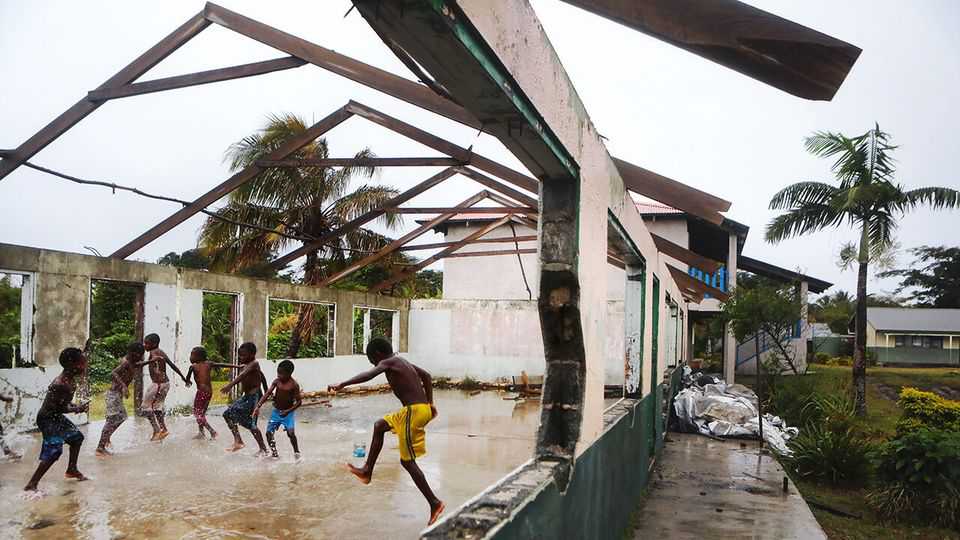
Nguna is one of the smaller of some 83 islands that make up the South Pacific archipelago of Vanuatu. It hardly rates a mention in the global politics of climate change, but its people want their voices to be heard. After all, they are living with the effects—close up.
Inneth Tasururu teaches at the little school in Unakap, a village on Nguna just off the coast of Efate, where the capital, Port Vila, stands. Not so long ago she was a pupil playing in its playground. When asked where the sea was then, her eyes glaze over a little and she says just one word: “Far.” Locals estimate that in recent decades the shoreline in Unakap has come in by something like 20 metres. The school’s old football field is under water, and attempts to build coastal defences have all failed, washed away or broken by high tides and storms.
After each storm, changes can be seen. The shores of Nguna island and its neighbours are littered with fallen trees, undermined by erosion. Other trees have most of their roots exposed, ready to fall next. Metal spikes stand out in places, the ruins of failed defences, and the path to the school is being eaten away by the waves. “All the communities in the islands are affected,” says Whitely Tasururu, a local man who advises the government on the issue.
Vanuatu is sponsoring a United Nations resolution on climate change, to press for financial help based on a legal opinion last year by the International Court of Justice that countries can be held liable for their inaction on climate change. America is doing its best to scuttle this motion, and any action would anyway surely come too late for much of Vanuatu. People there laugh at Donald Trump’s claim that climate change is a “con job”. In Port Vila, Vanuatu’s Ministry of Climate Change has collected evidence that suggests the sea level is rising all around the country. According to the country’s meteorological service, it has risen by 11-15cm since 1993. That brings severe problems such as saltwater intrusion.
Olivia Finau William, a spokeswoman at the climate-change ministry, talks of people cooking in kitchens permanently half-full of water. “The majority of the population of the islands lives on the coasts,” she says. One cemetery has been washed away. Vanuatu lacks resources to deal with a crisis of this magnitude. It struggles to deal with its natural disasters, which are almost routine and can include earthquakes, tsunamis and volcanic eruptions, as well as recurrent powerful cyclones. It has declared its own climate emergency, but in practical terms that has not made much difference. It is a big problem for a small nation that lacks even a medical school.
One solution is to move people, but that has not proved easy. Vanuatu has a complicated system of traditional land-ownership, presided over by its Malvatumauri Council of Chiefs, a national body with political clout. In the distant past, Vanuatu was divided between dozens of tribal groups, each of which spoke their own language and never ventured outside their own area. Centuries ago, they might be killed for doing so. Today there is widespread intermarriage, but when it comes to moving there can still be tension. New arrivals can be seen as competition for the archipelago’s scarce resources.
Vanuatu’s leading expert in climate change is Robson Tigona, who lectures at the National University of Vanuatu. While shifting tectonic plates do affect Vanuatu, a volcanically very active country, he does not doubt that the general sea-level rises seen locally are ultimately linked to melting ice caps and glaciers in other parts of the world. Climate-change sceptics should come to the Pacific, he says, and see the situation for themselves. ■