Cai Qi may be China’s second-most powerful man
Xi Jinping’s chief of staff handles his security, schedule and more
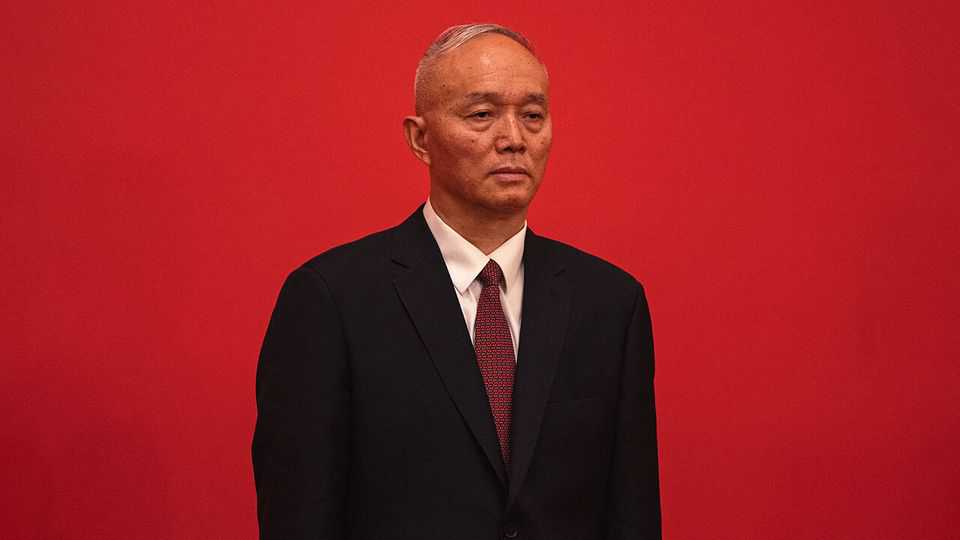
If the leaders of China and America meet in Beijing in the middle of May as planned, look out for a tall, white-haired figure sitting immediately to the right of Xi Jinping, the Chinese president. Cai Qi may be the second-most powerful person in China. As Mr Xi’s right-hand man, in functional terms as well as seating plans, Mr Cai has insight into almost every area of policy and access to many of the Communist Party’s secrets. That makes him a person of substantial interest to American officials and to many other foreign governments. It also raises questions about his future, given Mr Xi’s tendency to sideline—or purge—even his closest allies.
Mr Cai, who has known Mr Xi for over three decades, technically ranks fifth among the seven members of the Politburo Standing Committee, the party’s top leadership body. But he is the first in more than four decades concurrently to head the party’s powerful General Office. That means he acts as Mr Xi’s chief of staff, controlling his schedule and the people and information that reach him. He is often physically close to Mr Xi, too, usually accompanying him on trips within China or abroad and even supervising his medical care.
Mr Cai is also entrusted with Mr Xi’s personal security as head of the Central Guard Bureau, a plain-clothes force that protects (and keeps a close eye on) current and retired leaders. That position has always been a politically sensitive one, but has become even more so lately with Mr Xi’s purge of some three dozen generals since 2022. They include General Zhang Youxia, China’s most senior uniformed officer, who was placed under investigation in January. Central Guard Bureau personnel are likely to have been responsible for detaining General Zhang, who was accused of defying Mr Xi’s authority.
On top of those duties, Mr Cai is head of the Central Secretariat, the body which implements leadership decisions and manages day-to-day operations of the party apparatus. That gives him oversight of multiple portfolios. And among still more posts, he is thought to lead a party commission that has responsibility over cyber-affairs and to serve on the National Security Commission, a secretive body believed to include senior police officers, as well as intelligence and military officials.
The breadth and depth of Mr Cai’s responsibilities is highly unusual in party history. “It gives him access not just to the party’s sensitive documents, but also to the security services and potentially the military as well,” says Jonathan Czin, a former China analyst at the Central Intelligence Agency. “Whenever people ask me, ‘What happens if Xi were to drop dead tomorrow and there was no succession plan, who would get the top job?’, Cai Qi seems like the obvious answer.”
He now appears to have broader powers even than Li Qiang, who heads the State Council, or cabinet, as China’s premier and second-ranking party leader. Mr Li also has long-standing links to Mr Xi, having worked with him in eastern China in the 2000s. Still, Mr Xi may have engineered the current power structure to counter-balance Mr Li and ensure the party’s pre-eminence over the State Council, suggests Wu Guoguang, a former political adviser to China’s leadership who is now at Stanford University. “The number two is always the most possible guy to challenge the great leader,” he says.
Whatever Mr Xi’s thinking, Mr Cai seems to be playing a much more active role in diplomacy than previous General Office chiefs. Like them, he usually sits next to Mr Xi in meetings with foreign leaders, including one with Donald Trump, America’s president, in South Korea in October. But Mr Cai has also recently met foreign visitors alone, including leaders of India, Egypt and Turkey. In 2024, he met two American financiers, John Thornton and Stephen Schwarzman, who are sometimes seen as back channels to Mr Xi.
The second Trump administration has also sought a solo meeting with Mr Cai (so far unsuccessfully). In Britain, meanwhile, Mr Cai was identified last year as an important figure in a failed British government attempt to prosecute two people accused of spying for China. A high-ranking British security official at the time testified that in 2022 one of the defendants met a senior Chinese leader who had become Beijing party chief in 2017 and had joined the Politburo Standing Committee five years later. Only Mr Cai fits that description.
Foreign officials (and politically minded Chinese) are now watching closely for hints about Mr Cai’s future. Already 70 years old, he would until recently have been expected to retire at the next five-yearly party congress, in 2027. But Mr Xi, who is now 72, broke retirement norms when he secured a third term in 2022 and is now expected to seek a fourth. He could still force Mr Cai and other senior figures to retire, to bring new blood into the leadership and ensure that nobody accumulates enough power to be a threat.
Though Mr Xi’s earlier reshuffles and anti-corruption probes mostly targeted his predecessors’ protégés, he has recently ousted many he appointed himself, especially military officers. The downfall of General Zhang, a family friend, showed that none of the elite is safe. But Mr Xi may find it increasingly hard to replace those he has purged or sidelined with figures he trusts, having worked with them in the past. So he may want to keep veterans like Mr Cai around for their experience and proven loyalty, says Neil Thomas of the New York-based Asia Society Policy Institute. “Maybe we’re entering a new era of old-man politics in Beijing,” he says.
Mr Cai’s relationship with Mr Xi is partly based on shared experience. Born in the eastern province of Fujian, Mr Cai was sent to work in the countryside as a teenager, like Mr Xi, during the Cultural Revolution that raged across China between 1966 and 1976. When Mr Xi was posted to Fujian in 1985, Mr Cai was a junior official there. He later spent some 15 years working closely with Mr Xi in Fujian and neighbouring Zhejiang province.
His big break came in 2014 when Mr Xi brought him to Beijing to join the National Security Commission. Within three years, Mr Cai was elevated to the Politburo, the party’s top 25 leaders, despite not having previously been in the broader Central Committee. He then became mayor and later party chief of Beijing, where he appears to have impressed Mr Xi by forcing out migrant labourers, tackling air pollution and managing the capital during the pandemic. He was also an energetic advocate of absolute loyalty to Mr Xi.
All of that suggests that the president values him as a hard-nosed enforcer and administrator. More importantly, he is not seen as a threat, as his swift promotion from relative obscurity means he does not have his own political powerbase. Instead, he derives his authority entirely through his relationship with Mr Xi. That helps to explain his unusual appointment in 2023 to lead the General Office soon after joining the Politburo Standing Committee.
Only one other person has held these two posts simultaneously: Wang Dongxing, in 1977-78. A former bodyguard to Mao Zedong, he played a central role in toppling the so-called “Gang of Four” who seized power after Mao’s death. The political sensitivity of the General Office came into focus again in 2015 when Ling Jihua, who had led it under Mr Xi’s predecessor, Hu Jintao, was convicted of taking bribes, abusing power and illegally obtaining state secrets. Around the same time, Mr Ling’s brother defected to America.
Mr Xi will thus have to choose carefully when it comes to handling Mr Cai’s future. Aides and advisers can easily be replaced. Trust cannot. ■