AI and the associated risks are challenging policymakers to develop regulations quickly
Also this week, Thomas Malthus, academic status, measuring buffet portions
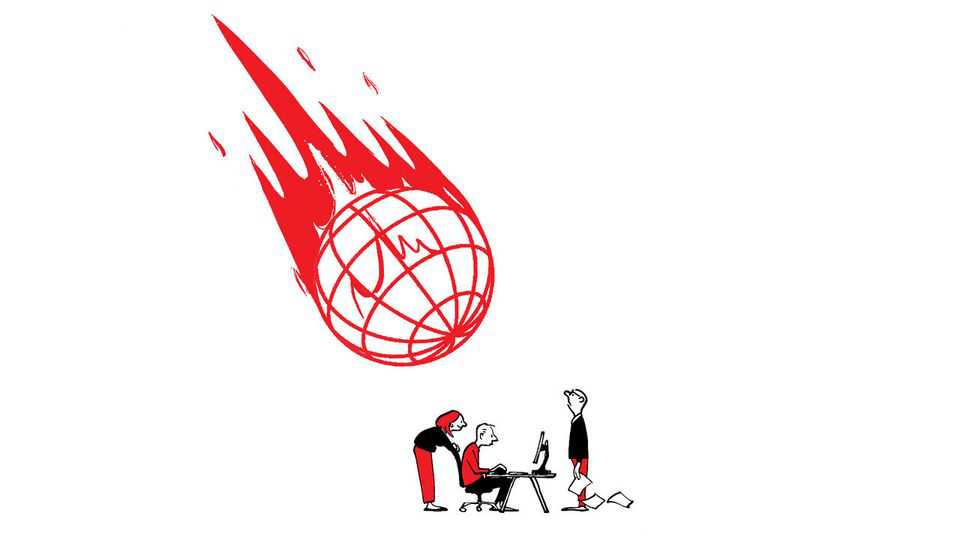
Your leader on “The Mythos moment” (April 18th) marking the release of Anthropic’s latest model did a good job of covering the current state of AI policy. Rapid advances in AI and the associated risks are challenging policymakers to develop regulations quickly and the need for international co-ordination is becoming clearer. However, the stakes, and the urgency, are even higher. Most experts believe AI poses a 5-10% chance of causing human extinction or some other catastrophe. Euphemisms like “AI-induced chaos” sugar-coat the very real possibility, acknowledged by experts and AI firms themselves, that humans will lose control of AI entirely.
The Economist has acknowledged the risk of extinction, so why not mention it in your leader? Meanwhile, Anthropic recently dropped its safety pledge to not release systems it believes could cause catastrophic harm. Anthropic is also in the process of handing off not just coding, but AI R&D to systems like Mythos, hoping to spur a “recursive self-improvement” loop and develop superintelligent AI.
Superintelligent AI is recognised by experts as a threat to humanity. Anthropic is betting that AI systems like Mythos will also help produce novel insights needed to keep it safe, but nobody should be allowed to gamble with the future of humanity.
David Scott KruegerAssistant professor in robust, reasoning and responsible AIUniversity of Montreal
When discussing who’s accountable for AI no one mentions the investors financing this technology. AI systems are shaped by capital as well as engineers and regulators. Investors determine which applications are prioritised, which systems scale, which innovations reach the market, and which ones are shut out.
Too few market-moving investors have taken a stance on AI governance. One consequence is that Big Tech has become synonymous with military tech, and remains largely unregulated. Companies now readily supply AI solutions for defence. This shift has occurred so quickly that conventional investor due diligence is struggling to keep pace. In practice, investing in parts of the technology sector is becoming indistinguishable from investing in war.
The industry’s accelerated timelines leave little opportunity for integrating international law or important safety considerations that high-risk tech requires. But market incentives, like war itself, are human-made. Even light-touch safeguards can help prevent dangerous systems from harming people and the planet, through human-rights due diligence, transparency on military applications, and clear red lines on high-risk defence-related AI investments.
Michael ClementsExecutive directorBusiness and Human Rights CentreLondon
A comparison is made between today’s titans of AI and Rockefeller and Ford. But given the potential destructive power of Mythos perhaps the Manhattan Project would be a better analogy. The film “Oppenheimer” made the argument that the scientific community is better placed to determine how such power is used. But with AI we want the government to be in control, as it was with the Manhattan Project.
We have managed to survive 80 years in the nuclear age. That’s at least cause for hope.
Elliott MilsteinBoynton Beach, Florida
The Free Exchange column on the latest research into ending poverty (April 11th) described Thomas Malthus as “a particularly dismal dismal scientist”. People who met Malthus, including those who disagreed with him, enjoyed his company. His sense of humour is apparent in his “Essay on the Principle of Population”, where he criticised William Godwin’s failure to produce evidence for his belief in the perfectibility of mankind by considering how you would support the proposition that humans are turning into ostriches.
As a young curate, Malthus was appalled by the living conditions of his parishioners and embarked on a life-long quest to analyse the root causes in the hope that a proper understanding of them would lead to happier lives for people in the poor and middling ranks of society. He criticised the wishful thinking of utopians such as Godwin and Nicolas de Condorcet (both friends of his) and believed strongly in the importance of unprejudiced assessment of evidence.
His warning against undue optimism remains as relevant as ever: “The most baleful mischiefs may be expected from the unmanly conduct of not daring to face truth because it is displeasing.”
Simon MollisonOxford
Bartleby’s column in the April 4th issue noted that status and job titles remain the currency of office life. British universities illustrate the point neatly. Professors still enjoy status but are stripped of the line authority that once made academic structures work. Managers in academia, by contrast, enjoy line power but little respect.
The predictable outcome is a surplus of bureaucracy and a shortage of goodwill. Those best placed to nurture intellectual excellence lack the power to do so, while those empowered to regulate lack the status to persuade. Universities increasingly resemble organisations run by people with power but little status, overseeing people with status but little power. It is a curious way to govern institutions supposedly devoted to reason.
PROFESSOR DAVID COLDWELLWinchester
“Smarter spreads” (April 18th) reported on a computer model that is looking at ways to make buffet breakfasts less wasteful, and found that people who go back for seconds tend to finish what they take. This is reassuring. As a frequent business traveller I have long suspected that my second visit to the reconstituted scrambled eggs served a larger purpose.
Josh DeLayBentonville, Arkansas
Absent from the list of motivations for buffet eaters is maximising the feeling of satisfaction from getting a good deal. Price-sensitive guests, such as travelling sports clubs and families with teens, often load up their plates without restraint. However, this behaviour is easily curbed by placing a sign at the buffet cart that reads: “Clean-plate policy: pay-by-weight for leftovers.”
Lorraine Byerley Ottawa
The acronym for the project “Changing Practices and Habits through Open, Responsible and Social Innovation towards Zero Food Waste” doesn’t even remotely spell CHORIZO. Whoever came up with it in Europe is a silly SAUSAGE (Self-Assured, Unreformed Sesquipedalian And Garrulous Eccentric).
Sam WilkinBrussels