A tour of Brazil’s wildly polarised politics
Lula’s voters and Bolsonaro’s voters don’t agree on much. But they all hate the corruption that plagues Brazil
It is one of the world’s most unequal countries. Thanks to its colonial and slave-importing past, Brazil is one of the most racially mixed countries, too. To cross it can feel like visiting different continents. The Amazon jungle gives way to deserts and palm-lined coasts in the north-east. Most of the population is mixed-race. Fly south, and villages are dotted with Fachwerk houses and vineyards, built by the white descendants of German and Italian immigrants. São Paulo is the helicopter capital of the world, in which elites are whisked to and from their penthouses on some 2,000 flights a day. Meanwhile, in Santarém, a city in the Amazon, 96% of residents have no sewerage.
One might expect such disparities to foster deep political division. In the 2010s, after three decades of democracy, Brazil had become more polarised. The dominant political force, Luiz Inácio Lula da Silva’s Workers’ Party, wobbled with corruption, facilitating the rise of Jair Bolsonaro, a right-wing populist, who became president in 2019. The clash between the two men and their followers has defined Brazilian politics since. In 2025, for a brief moment, it looked as if the country might be preparing to move on, as Mr Bolsonaro was jailed for plotting a coup. With a general election due this October, many thought he might have to endorse a moderate figure from outside the family to run in his place. But he chose his son, Flávio, a senator. The left is lining up behind Lula, now 80, for his seventh presidential campaign. Another divisive election looms.
To understand what is driving Brazil’s 213m-plus people apart,The Economist travelled to the municipalities that voted most sharply for Lula or for Mr Bolsonaro in the presidential election in 2022. Predictably, voters disagreed strongly on Mr Bolsonaro’s imprisonment and on the role of the state in the economy. But there were also areas of consensus. All Brazilians revile the corruption that pervades their politics. The vast majority are deeply religious. Most believe that reforms are needed to curb the country’s powerful Supreme Court. Despite recent increases in real wages, many Brazilians lament the high cost of living. Brazil may be divided, but voters have more in common than they think.
In Petrolina, a city in the north-east, it is clear which way voters swing. A replica of the Statue of Liberty outside a department store owned by a Bolsonarista businessman has been burned down. It was set ablaze in September, when Mr Bolsonaro was convicted. On the drive to Guaribas, a town of 4,500 where 94% voted for Lula in the previous election, pick-up points for subsidised cooking gas, one of his flagship handouts, pop up along the main road.
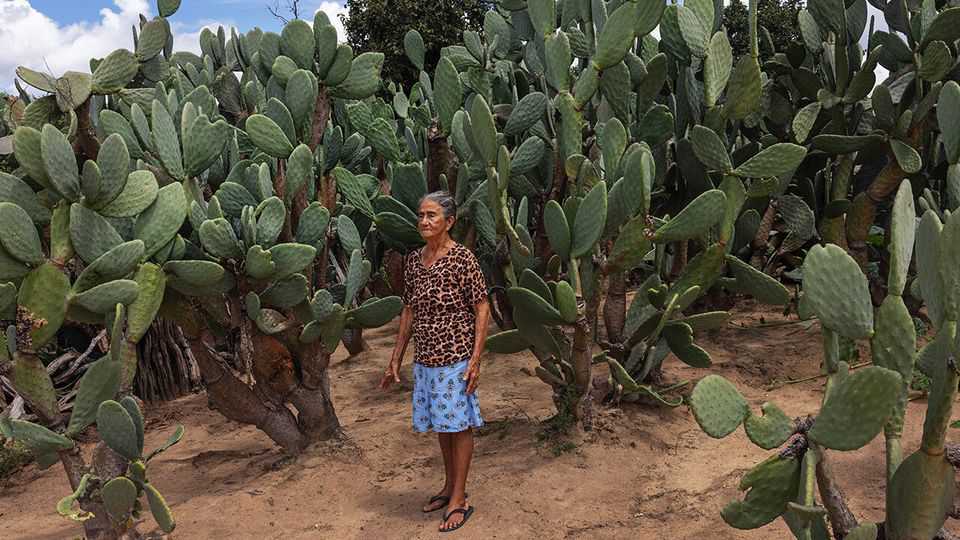
It is the end of the short rainy season, and the landscape is dotted with flowering cacti and umbu trees heavy with yellow fruit. For the eight months that follow, not a drop of water will fall in these parts, which revert to arid scrubland. Almost 13% of the region, known as the sertão, is in advanced stages of desertification.
“When I was a child, life was very painful,” says Obaniel Fernandes da Silva, a local. “We had no water, no food, no medicine and no school.” In the neighbouring village, a group of women talk over each other, eager to recount their stories. “Sometimes we’d go three or four months without a bath,” says Iracy Ribeiro da Rocha, 72. “It was more important to use the water to cook.” One woman lifts her skirt to reveal a bulging vein acquired when, heavily pregnant, she was forced to trudge for miles to the water hole.
Since then, a battery of government programmes has transformed the municipality, once Brazil’s poorest. When Lula first came to power, in 2003, he chose Guaribas as the site to pilot two welfare schemes, Bolsa Família (Family Grant) and Fome Zero (Zero Hunger). The first gives heads of households, overwhelmingly women, a cash handout of 680 reais ($136) a month, on average. In exchange, parents must send their children to school and get them vaccinated. Only households earning less than $44 a month per member are eligible. The programme costs $32bn a year, or 1.2% of GDP.
Fome Zero provides family farms with technical help and organises them into co-operatives. The state then buys their produce and distributes it to public schools and hospitals. In addition, the government provides water cisterns in rural areas, as well as clinics that have sometimes been staffed with underpaid Cuban doctors.
Such initiatives helped to reduce the number of Brazilians living on less than $3 a day from around 30m in 2002 to fewer than 7m today. “If it weren’t for him, we would have died of thirst and hunger,” says Ms Rocha of Lula. “Whoever doesn’t vote for Lula deserves a kick!” After two decades of state intervention, many in the next generation are becoming independent. Natalícia Pereira Silva, headmistress of Guaribas’s secondary school, beams as she explains that recent alumni include lawyers, engineers, accountants—and soon its first doctor.
Yet despite the progress of the young, almost every family in town still receives Bolsa Família, as well as free or subsidised cooking gas and electricity. There are hardly any shops, and few jobs not provided by the government (the new lawyers and accountants are among those who left to find work). “We don’t have a federal plan to help people in the medium and long term to find work and get out of these programmes,” says Diogo Siqueira, a Bolsonaro-aligned former mayor of Bento Gonçalves, a prosperous town in the south. He is running for Congress on a campaign to cut government assistance by finding jobs for its beneficiaries.
Welfare irks Brazil’s right-leaning voters more than most issues. Some 19m families in Brazil, around a quarter of the total, receive Bolsa Família, and 7m of these have done so for a decade or longer. Many beneficiaries have low-paid jobs. But fraud is also common. In Guaribas, for example, the census lists 151 single-parent households—yet 617 families told the welfare registry they were headed by a single parent. Many evidently don’t admit to having a second earner in the house.
“Our region is one where people are focused on family, work and order,” says Odeli Sonda, a fruit farmer in Nova Pádua, a town in southern Brazil made up of Italian descendants. Some 90% of its voters backed Mr Bolsonaro in the most recent election. “We know that a left-wing government doesn’t have those priorities.” Behind him a dozen relatives are already hard at work at 8am, packing grapes and pears into boxes and loading them onto lorries heading for distant cities.
Graziela Boscato, a vintner whose elderly father still works the fields, thinks that “the president of the country” should be chosen by “those who contribute to it”, not by people who are on welfare. “The handouts they get come from the taxes that we pay.” Entrepreneurial southern farmers themselves benefit from a temperate climate and good roads.
Ironically, it was Mr Bolsonaro who turbocharged the number of Bolsa Família recipients and the amount of money paid out, as part of a splurge in advance of his re-election attempt. In 2018, when he was elected, there were 14m recipient families and the average handout was $48 per month. By the time he left power, 21m families got an average of $115.
Adding to the anger over handouts is a sense that taxes are too high and that public money is often stolen. The state should “invest in public health and public education”, says Mr Sonda. “Instead my taxes fund corruption.” Ms Silva, the headmistress in Guaribas, agrees: “Corruption has infiltrated everything.”
Brazilians of all stripes are angry about recent scandals involving the powerful Supreme Court, which have revealed connections between several judges and the leader of a massive bank fraud. “The branch of government that’s supposed to be our last line of defence is even more mixed up in corruption than our politicians, so there’s nowhere to turn,” says Ezequiel Pan, a lorry driver in Nova Pádua. In a recent poll, three-quarters of Brazilians said Supreme Court judges have too much power.
Another common grumble is that living costs are too high. From Nova Pádua to Guaribas, some former Lula voters say they will support Flávio this time because, they reckon, life is unaffordable. Several people hint that they are struggling to service their debts; one in four Brazilians say they have fallen behind on repayments. Brazil’s benchmark interest rate is a whopping 14.75%. The average annual rate on credit cards has risen to an eye-watering 452%.
Corruption, judicial checks and balances, complaints about basic prices: this is hardly the stuff of a divisive culture war between two political extremes. If a middle-of-the-road candidate is not emerging, it is not for lack of demand. ■