A radical idea for governing California
Democrats could try picking a young candidate who has a solid record of running a big city
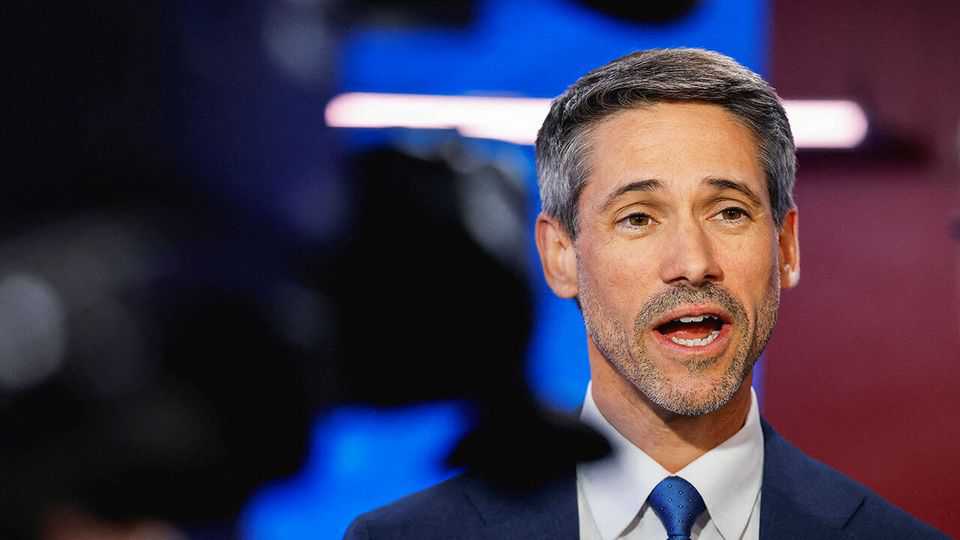
Much political campaigning consists of spending time in diners accosting unsuspecting voters. And so on a recent Friday in Los Angeles Matt Mahan, the 43-year-old mayor of San Jose and a candidate for governor of California, sat down at Langer’s Deli to enjoy the #19 (pastrami, swiss and coleslaw on rye). He was flanked by Norm Langer himself (who urged patrons to “Eat!”), and booths occupied by locals worried about homelessness and drug use in nearby MacArthur Park. “Every politician runs on homelessness being a crisis, and then we just manage it,” said Mr Mahan. “It’s unfair, and we’re going to fix it.” Then he hoisted the sandwich (“World’s best!”), and took a bite.
When he entered the crowded governor’s race in January, Mr Mahan was a long shot. But an uninspiring field of candidates, a scandal that torpedoed a front-runner and California’s nonpartisan primary, in which the top two candidates go through to the general election, has made the race unpredictable. Though the primary is not until June 2nd, ballots will be posted to voters from May 4th. So Mr Mahan has little time to make his pitch. He argues, essentially, that California needs a pragmatic problem-solver in Sacramento who will stand up to his own Democratic allies as well as the president. His campaign represents an idea (popular on the wonkier edges of his party) that the best defence against Trumpism is proving that Democrats can govern effectively in places they already run.
Mr Mahan grew up on Rainbow Lane in Watsonville, a farming town in a corner of California best known for Steinbeck and strawberry fields. He received a scholarship to attend a Jesuit prep school in San Jose. His two-hour commute was like a relay race: dad drove him to Corralitos, where he was picked up by a friend who ferried him to the outskirts of Santa Cruz. One bus took him over the mountains to downtown San Jose, where he could board another that dropped him five blocks from school. Bus rides were for sleeping, homework and reading the Pajaronian, a local newspaper. “I imagined being like Bilbo Baggins leaving the Shire,” says Mr Mahan, revealing his inner nerd. “It was like we were going on a journey every day.” It’s a routine that may resonate with many Californians who drive hours from towns where they can afford housing to jobs in the state’s superstar cities.
That school catapulted Mr Mahan to Harvard, where he overlapped with the likes of Pete Buttigieg and Mark Zuckerberg. Joe Green, his campaign chairman and college friend, describes Mr Mahan as a Boy Scout—though, he offers, “he could do a pretty long keg stand” (30 seconds, according to the campaign). With friends like these it is unsurprising that Mr Mahan returned to Silicon Valley and eventually co-founded Brigade, a platform for political discussions. Since 2023 he has tried to blend tech and civics as mayor by, for example, using artificial intelligence to co-ordinate traffic signals so buses are not caught at red lights.
Mr Mahan’s campaign is based on his record in San Jose, California’s third-largest city. Consider two of the state’s most pressing problems: a housing shortage and homelessness. San Jose is not exactly a YIMBY paradise, but Mr Mahan is trying to reduce fees and red tape to make it easier for developers to build housing. Rather than spending years and millions building permanent housing for homeless people, he argues, cities should erect shelters to bring people inside quickly. The number of homeless people in San Jose has stayed fairly steady since 2019, but the proportion with a roof over their heads has increased from 15% to nearly 40% in that time. Critics of this approach argue that shelter hides, but does not solve, the problem. The Angelenos lunching at Langer’s Deli might retort that, under such a system, they would at least get their park back. “There’s always trade-offs,” Mr Mahan says. “I never want to pretend that there’s just an easy answer.”
Mr Mahan’s centre-left politics and startup mindset have endeared him to some Californian tech moguls, who have donated to his campaign. Their millions help finance ads in the state’s expensive media markets, but some voters worry that the mayor would be beholden to billionaires. “We have to regulate tech where it makes sense,” Mr Mahan told a crowd at a building designed by Frank Gehry in Santa Monica. He failed to convince Sarah Spitz, a former radio producer in attendance. “I’d rather back the populist billionaire than the tech bros,” she scoffed, referring to Tom Steyer, the self-described “billionaire who wants to tax other billionaires”.
Mr Mahan’s biggest challenge will be introducing himself quickly to California’s 23m registered voters. “There’s an old saying in California politics that San Jose is where political careers go to end,” says David Crane, a Stanford University lecturer and a supporter of Mr Mahan’s. “He was an absolute unknown.” The city is more populous than San Francisco, but few outside (or even inside) California would guess that. Even some of Mr Mahan’s biggest fans in Santa Monica were still learning the basics of his biography. Before the mayor took the mic a film producer leaned over to The Economist and whispered: “Is it May-han or Ma-hahn?” (It’s May-han.)■