The costs of dating your boss
New research shows breakups come with big wage penalties

In "Selling Sunset", a Netflix reality show, a group of estate agents strut through the Hollywood Hills in stilettos competing for listings. Office envy erupts when romantic ties to the boss allegedly earn one woman a particularly lucrative listing. According to Emily Nix, an economist at the University of Southern California, the show represents "exactly the dynamics" that she and her co-authors set out to examine in a new working paper.
A quarter of Americans admit to having had an office romance. Yet not all work relationships are equal. Those between managers and their subordinates are particularly prone to generate controversy. In many companies they are now explicitly prohibited. Even so, surveys suggest they continue to take place. Little is known about the implications of such relationships for those who embark on them, or for their employers.
An unusually rich trove of data from Finland—on employees' wages over time, the positions they hold at their firms and with whom they live—has allowed Dr Nix and her co-authors to shed light on the matter, tracing how income trajectories shift when a subordinate enters into (or ends) a relationship with their manager. The research suggests that workers mulling a dalliance with their boss should tread carefully.
To isolate the effect of a female subordinate dating a male manager (by far the most common situation), the authors compared these couples with those in which a woman pairs up with someone more senior than them at a different workplace. "When you meet someone wonderful, you might become more productive simply because life is good," says Dr Nix. Coupling up with someone with more professional experience may also yield benefits beyond the potential for favouritism.
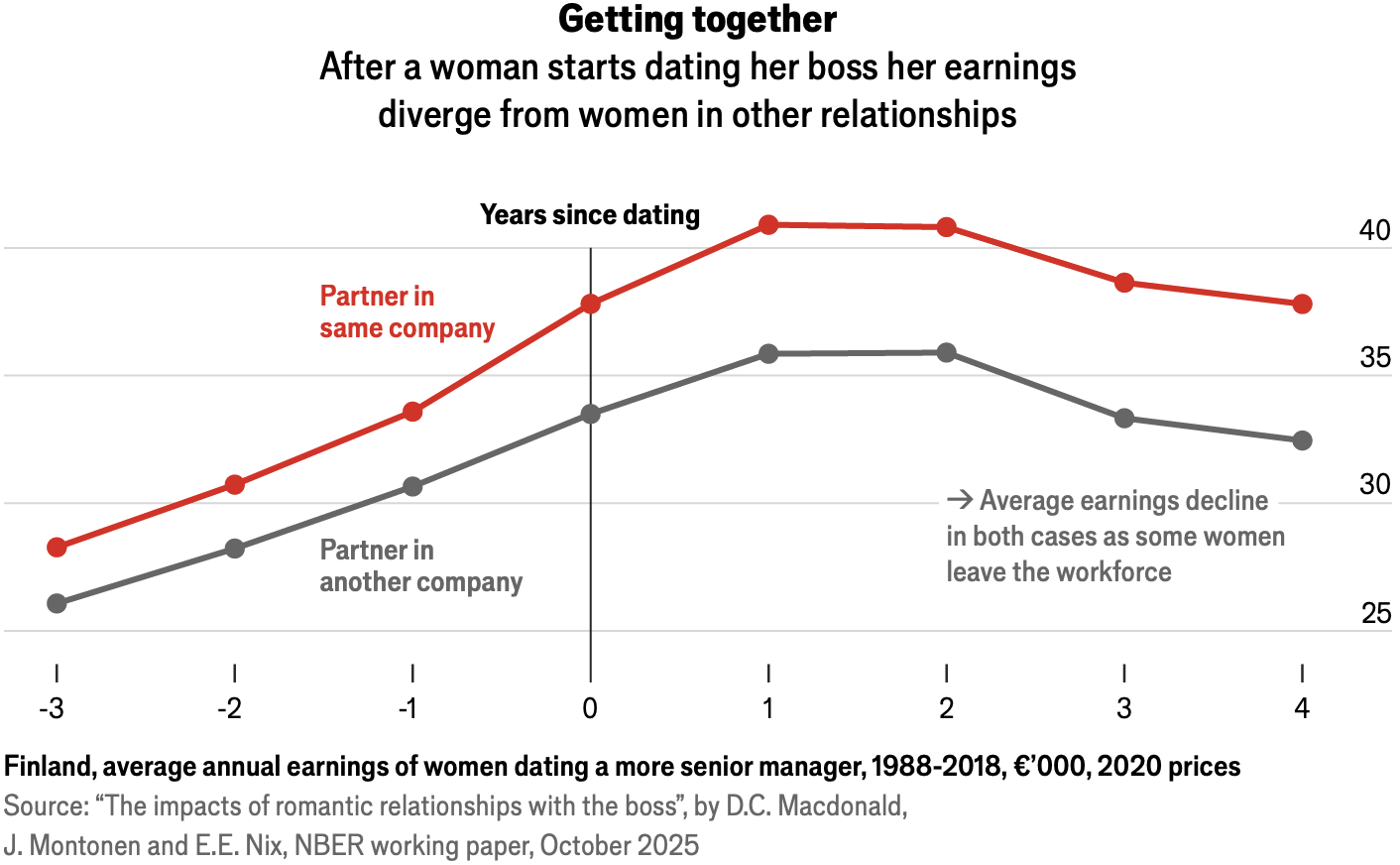
In the absence of more precise data, the authors assumed that the relationships they examined began two years before a couple moved in together (survey evidence suggests that around 70% do so within that timeframe). Pin-pointing breakups, using the date at which couples ceased living together, was more straightforward.
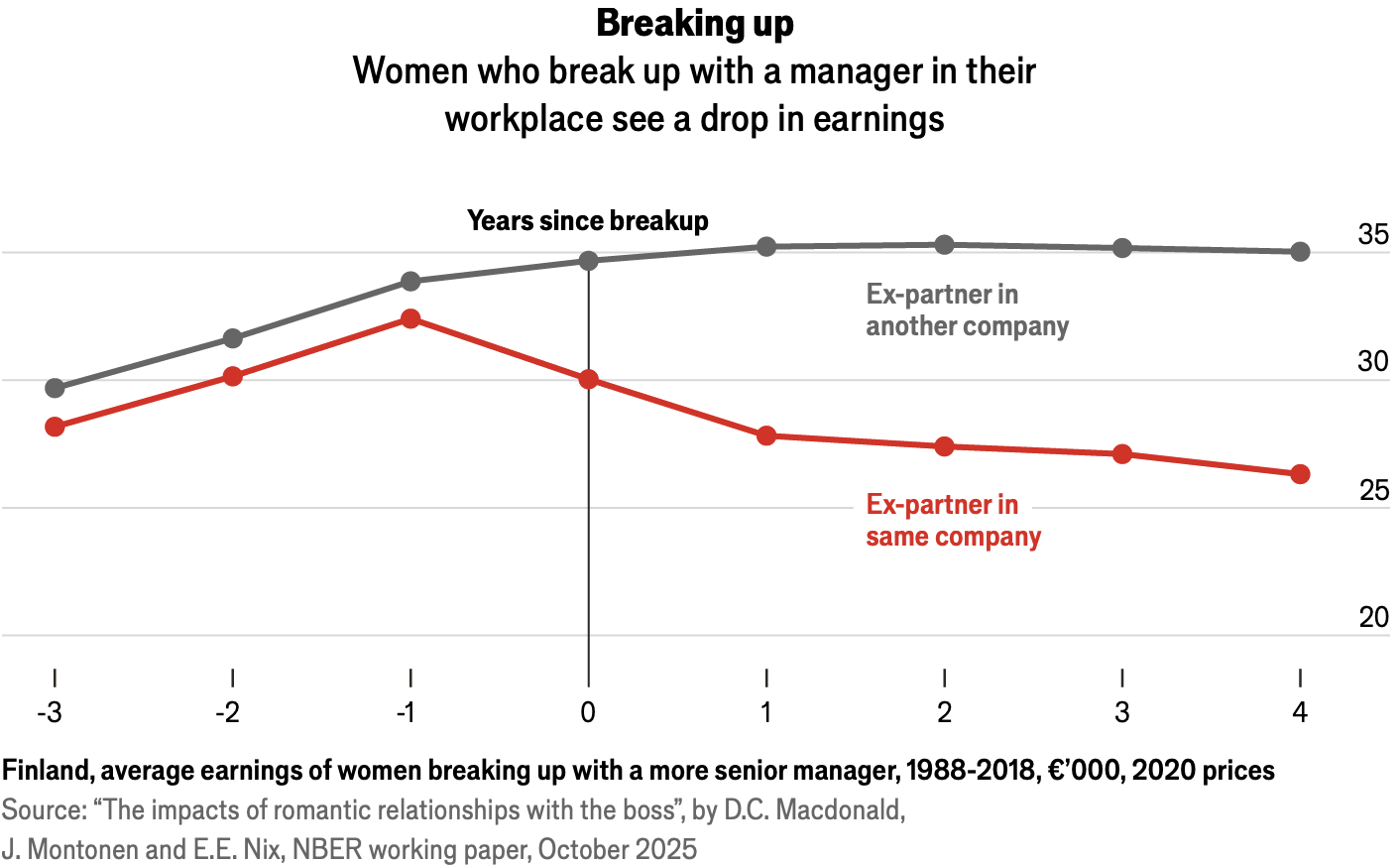
The good news for those pining after their boss is that, on average, such relationships led to a 6% increase in income for the woman compared with the control group, with the gap forming over the two years before the couple moved in together. The bad news is that women who broke up with their boss—and often left their job as a result—saw their income decline by an average of 18% compared with the control group within a year. It continued to fall over the subsequent four years.
Where male subordinates dated female managers, the size of these effects differed significantly. Men in relationships with female bosses enjoyed roughly twice the bump in pay of women dating male bosses. Women who broke up with their bosses also experienced a much sharper drop in income after the separation. That is partly because they were much more likely to leave the workforce entirely.
These relationships pose risks for employers, too. Not only could they lose those workers for whom a relationship with a boss ends. They may also suffer a wider drag on retention. Companies in the study that had manager-subordinate relationships saw a subsequent decline of six percentage points in employee retention compared with those that did not. Smaller firms suffered a bigger effect, as did those where the subordinate in the relationship received a larger bump in pay. Employees seem to bristle at the perceived favouritism. In a poll by YouGov and The Economist, 71% of American respondents said that workers in a romantic or sexual relationship with their manager received more favourable treatment.
All this explains why many companies keep a watchful eye out for such intrigue. In more hierarchical cultures than Finland, relationships between managers and subordinates, when they do occur, could have even more detrimental effects, both for employers and employees. Those looking yearningly across the office may want to think twice.■