Which Iran is America dealing with?
With talks set to resume, rivalries among Iran’s leaders could stymie a truce
 April 23rd 2026
Even before the first round of talks between America and Iran had begun, Iran-watchers sensed that something was askew. Delegations dispatched for talks with America are usually lean, disciplined and tightly briefed. The one in Islamabad, the Pakistani capital, was anything but. Some 80 Iranians joined the flight on April 10th, among them roughly 30 billed as decision-makers. They included diplomats who had helped write Iran’s 2015 nuclear deal and a firebrand mp who denounced any deal with America. Rancour in their hotel was so ferocious that Pakistani mediators spent as much time refereeing the Iranians as engaging with the Americans.
The indecision coming out of Iran signals a power struggle. For only the second time in its 47-year history, it is without a present and absolute supreme leader. One observer likens the situation to “a jungle of power”. For any future American delegation in Islamabad, this raises the question of who, exactly, they would be talking to.
The prime cause of the tensions is the vacuum at the top. Seven weeks after an American-Israeli air strike killed Ali Khamenei, the supreme leader for 37 years, his successors have failed to agree on a date for his funeral. His son and designated successor, Mojtaba Khamenei, may either be incapacitated or too weak to impose his authority. Israeli assassinations have thinned the army’s top ranks. Their successors lack their sway and experience and may heed the Islamist radicals who take to the streets every night. Most of all, Iran’s central command has been dispersed to guard against those assassinations. “Decentralisation is good for the system’s survival in war, but bad for its functioning when the fighting stops,” says an Iranian cleric who knows Mojtaba.
Since a ceasefire was declared on April 8th, the regime’s wartime cohesion has been fraying. Formal authority rests with the Supreme National Security Council (snsc), comprising the president, parliament’s speaker and the security services’ chiefs. Mohammad-Bagher Ghalibaf, the speaker, has been designated chief negotiator, with Abbas Araghchi, the foreign minister, as his lieutenant. But their apparent readiness to negotiate has provoked a backlash, particularly from the Islamic Revolutionary Guard Corps (irgc), the 190,000-strong force at the regime’s radical heart. Hence Iran’s pronouncements on the status of the Strait of Hormuz and whether to fight America or try diplomacy have been contradictory.
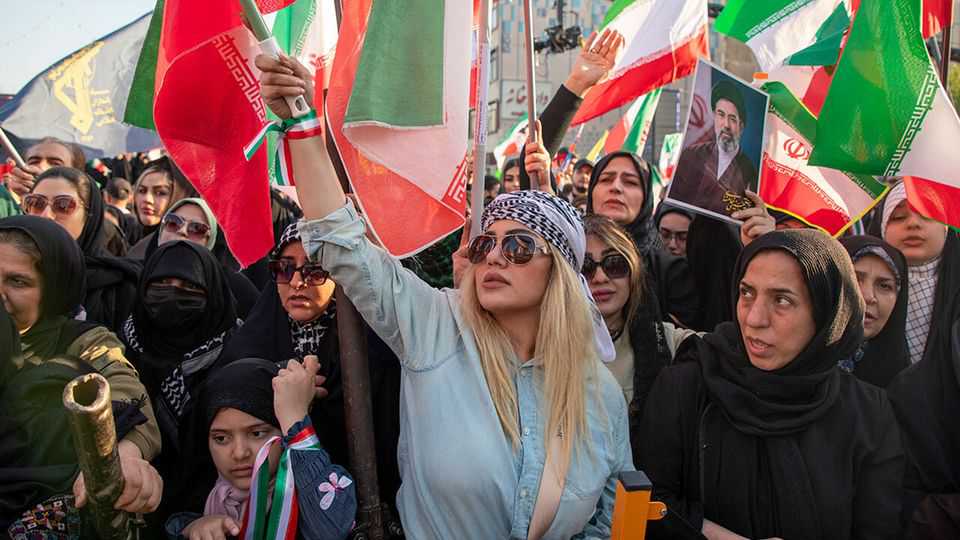
Pro-regime crowds in Iran have taken to denouncing Mr Ghalibaf and Mr Araghchi. Military communiqués issued by men in fatigues appear to have replaced sermons by clergy. Even puritanical dress codes seem to be slipping: at a recent rally an unveiled woman led chants, breaching the four-decade taboo on women singing solo in front of men. In a further sign of military control, outlets linked to the Guards have floated the idea of delaying municipal elections scheduled for May 1st.
Since toppling the shah in 1979, Iran’s leaders have disagreed on whether or not to confront America. But the faultline between nationalists guided by realpolitik and Islamists fired by revolutionary passion has widened. Many zealots now look to the security council’s secretary, Mohammad-Bagher Zolghadr. His hatred for America dates back to the 1970s, when he belonged to the Mansouroun, a militant group that kidnapped Americans.
Material interests muddy matters further. Over the years, a class of generals-turned-sanction-busters has emerged, benefiting handsomely from operations to circumvent American sanctions. America’s sea blockade may well bolster them as overland trade must expand via Iraq, Russia, Central Asia and China. Networks tied to Mojtaba Khamenei and Mr Ghalibaf are thought to control foreign-property portfolios and have attracted Islamist media scrutiny. With Khamenei senior gone, previously sidelined figures have re-emerged. Each brings different allies, agendas and claims on power.
Each faction has a different view on the key sticking-points in the talks, including the nuclear programme, control of Gulf waters and the role of Iran’s regional proxies. Nationalists would trade proxy networks for sanctions relief; ideologues see them as a force multiplier. Yemen’s Houthis might yet close a second maritime trade route, the Red Sea. For the nationalists, nuclear brinkmanship risks Iran being attacked, whereas the ideologues prefer North Korea’s model: get a bomb to bolster deterrence. Pragmatists see control of Hormuz as leverage for a wider security pact with the Gulf Arabs, while the ideologues see it more as a lucrative toll-booth and chokepoint on the world economy.
On April 15th Asim Munir, Pakistan’s army chief, visited Tehran, seeking common ground among Iran’s factions. The regime’s claims that it needs $270bn to repair war damage may help concentrate minds. But the depth of divisions among Iran’s bigwigs may explain why their regime has yet to say whether or when its representatives will return to Islamabad for more talks.■
Editor’s note, April 20th: This story has been updated