What do the geopolitical successes of Asim Munir mean for Pakistan?
Despite some breathless optimism, the military strongman is unlikely to deliver deeper change
 April 23rd 2026
On April 21st, hours before a ceasefire between America and Iran was due to expire, and with the threat of renewed strikes imminent, Donald Trump announced that the truce would be extended indefinitely, at Pakistan’s request, to let negotiations continue. Whatever happens next, Pakistanis have some reason for feeling proud. For decades the country has been known mainly for endless IMF bail-outs and terrorist insurgencies. Now it has shown itself to be a deft handler of global power politics.
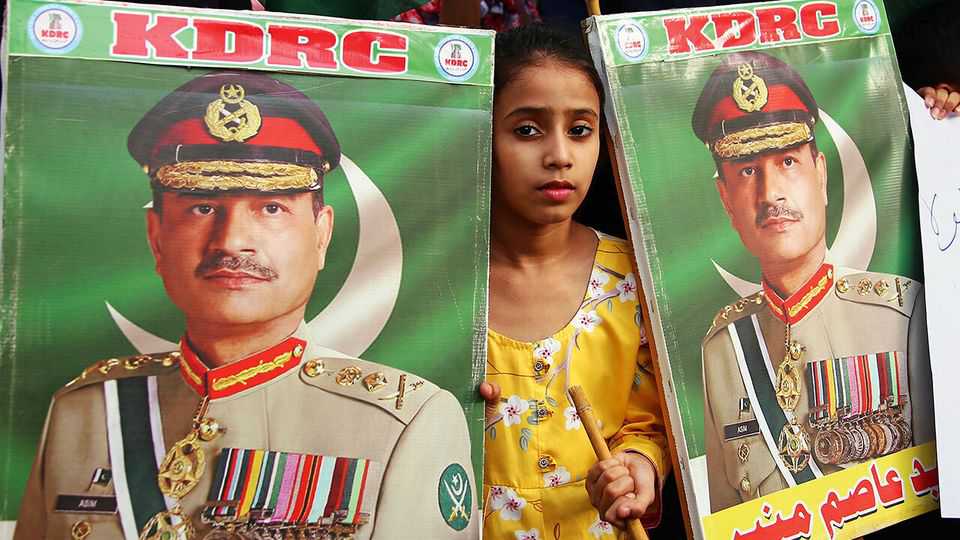
At the centre of all this has been the man whom Mr Trump has feted as his “favourite field marshal”. Throughout the crisis Asim Munir, the country’s mustachioed army chief, has been on the phone regularly to Mr Trump and his vice-president, J.D. Vance. Diplomats say he is immersed in the details; during the first round of talks last week he was often the only one of the principals seen diligently taking notes. The former spy chief spent three days in Tehran last week—he was the first high-profile visitor since the bombing stopped—meeting senior political and military leaders there. Soon afterwards the Iranians said they would open the Strait of Hormuz (only to backtrack in protest at Mr Trump’s blockade).
Some observers have been surprised by the nimbleness of the military strongman. But those in Pakistan who have watched his rapid rise say that he is sharp, wily, ruthless and ambitious. Appointed army chief in 2022, he has quickly emerged as Pakistan’s most powerful leader for a generation, first by securing his grip on the armed forces, then by hobbling the opposition and extending his influence over government. Thanks to some constitutional chicanery, he is thought to have secured his position for a decade, perhaps longer. No one in Pakistan doubts that he is the one—not Shehbaz Sharif, the prime minister—calling the shots.
Field Marshal Munir’s dream is to elevate the world’s fifth-most-populous country and its only Muslim nuclear power to what he sees as its rightful place in the international order, no matter that many millions of Pakistanis still struggle to get by. Can he take advantage of his moment in the sun—or will the dominance of yet another military strongman merely serve to deepen Pakistan’s many problems?
It is not the first time that Pakistan has involved itself in high-wire diplomacy. The country’s military leaders have long had a “fetish for playing on the global chess board”, says a former senior official. Pakistan spent three years running a backchannel between America and China ahead of President Nixon’s visit to China in 1972. But often, the official adds, such delicate work has at best provided an ego boost or strengthened the regime against internal challengers, rather than yielding benefits to the population at large.
The case that this time will be different starts with Iran. Despite the recent goodwill, the two countries have long had a tricky relationship, aggravated by insurgencies on either side of the border. Pakistan worries about flows of refugees if the war goes on, and its own large Shia population growing restive. But if it succeeds as a peacemaker, diplomats hope it will be well-placed to play a leading role in reconstruction, creating jobs for its crowds of young people. Pakistan’s seat at the table could also be used to push for the removal of sanctions that have halted a long-planned Iran-Pakistan gas pipeline.
Field Marshal Munir also hopes to flex Pakistan’s military muscle. After the war, Gulf states will feel more threatened and less sure of American protection, says Mushahid Hussain, a former senator. Pakistan’s most—many would say only—functional institution is a big, well-drilled army. Defence spending increased by around a fifth this year.
A mutual-defence pact with Saudi Arabia signed last year is seen as a model. Pakistan already has around 13,000 soldiers and 18 jets stationed in the desert kingdom. The deal has not been made public, but insiders say Saudi Arabia has promised investment in return for security guarantees. There is also growing talk of creating some kind of “Islamic NATO”—involving Egypt, Pakistan, Saudi Arabia, Turkey and perhaps others—to boost co-operation on defence and security.
The past few weeks have also been a reality check for India, says Hina Rabbani Khar, a former foreign minister of Pakistan. It has long aimed to isolate Pakistan diplomatically, and made a renewed tilt to do so after the two fought a four-day war last year. Instead it is Pakistan that has strengthened its role in the Middle East, and its relationship with both America and China, while India has found itself watching from the sidelines.
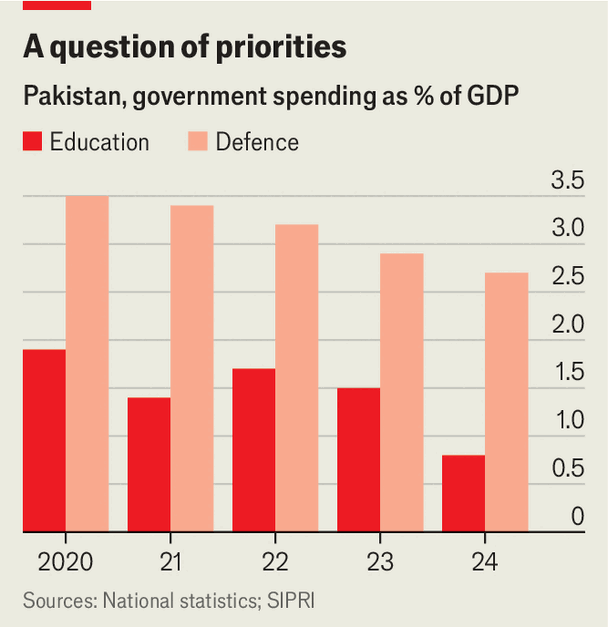
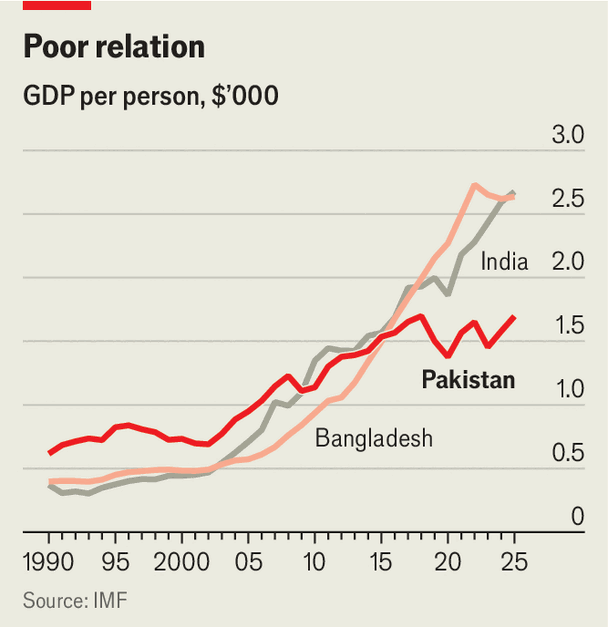
Though the field marshal has played his cards well, geopolitical success may end up doing little to stave off pressing problems at home. The twin spectres of the IMF and terrorist insurgency remain. Living standards have barely risen in a decade. The field marshal’s plan for making the economy work better largely involves extending military control over it. An investment council he chairs has yielded little. Anger over soaring fuel prices since the war began has so far been muted, but only because the regime has warned opposition parties not to hold protests. Big cities are experiencing gas shortages and rolling blackouts, and in the coming months food prices are likely to rise.
The worry is that if he is unable to alleviate such problems, Field Marshal Munir will be more likely to turn to repression. Imran Khan, a former prime minister, sits in solitary confinement. Having governed as a populist, he was ousted by the political and military establishment in 2022, then put away on specious charges. Behind bars his popularity has soared; his position now is “liberty or death”, says his sister Aleema. Seasoned observers doubt he will be released as long as the field marshal rules. Hundreds more have been locked up, according to opposition parties. “When we plan a protest, our people get picked up and taken to unknown places,” says Ali Zafar, a senator from Mr Khan’s party, the PTI, which has been partially dismantled. Fazal-ur-Rehman, a veteran Islamist politician, complains that the 2024 election was rigged, before adding that the field marshal is a “good man and a brave soldier”.
The country still has a nominally democratic constitution; the PTI even runs one of its provinces. But the field marshal has tilted Pakistan’s hybrid system even further towards military control. One insider suggests that only a façade of civilian government remains. Increasingly, the army’s dominance is openly acknowledged.
In the past, Pakistan’s generals have often preferred to wield power from behind the stage, letting politicians face the wrath of voters. One consequence of Field Marshal Munir’s ascendancy is that he has put himself front and centre.■