Virginia’s redistricting may be the nail in Republicans’ coffin
On current maps, our model sees Democrats as all but certain to flip the House
 April 23rd 2026
The sun rises in the east; the other queue always moves faster; and the president’s party loses the House of Representatives in the midterms. Starting with the Democrats’ blue wave in George W. Bush’s second term, this pattern has held firm every four years. Even Republicans’ weak performance in 2022, derided as a “red ripple”, ended Joe Biden’s trifecta.
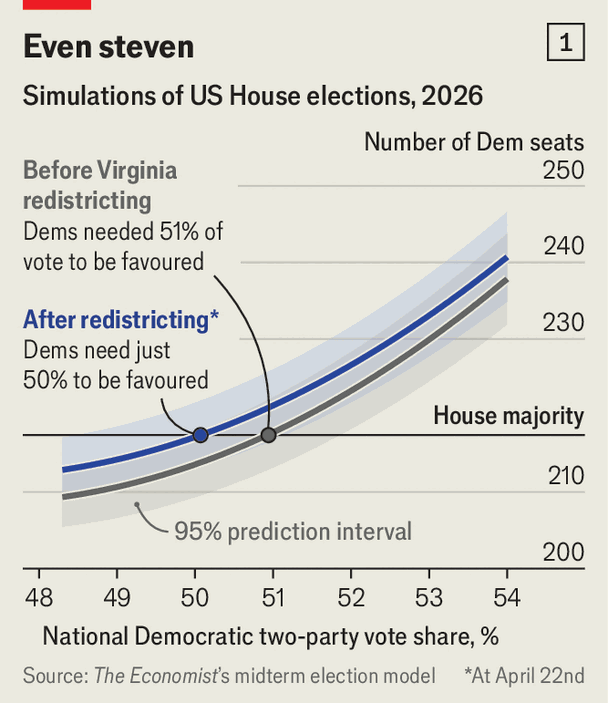
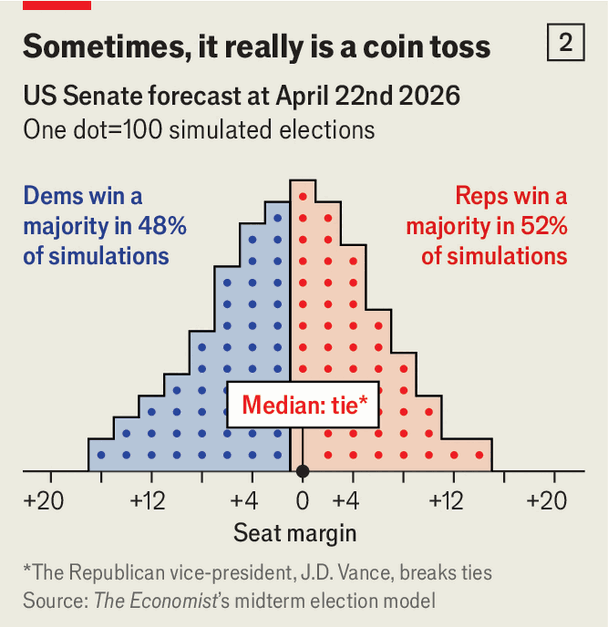
And although Donald Trump prides himself on breaking rules, in this respect he looks embarrassingly conventional. The Economist’s newstatistical forecastof the 2026 Congressional elections gives Democrats a huge 98% chance of gaining at least the three seats needed to flip the 435-seat lower house—up from 94% before voters in Virginia approved a referendum on April 21st that gerrymanders 3-4 Republicans out of their seats (see chart 1). More surprisingly, despite a Senate map that looks nearly impregnable on paper, the model estimates that the party has a 48% probability of taking over the upper chamber as well (see chart 2).
Given the unpredictability of elections—as shown by Mr Trump’s own victory in 2016—how can we be so certain? Although individual House races are thinly polled and frequently deliver upsets, district-specific surprises usually cancel out across hundreds of concurrent elections. If a party wins far more seats than expected, that is usually because it wins more votes than expected nationwide. And in modern times the national popular vote for the House has generally landed close to estimates based on “generic-ballot” surveys, which ask respondents which party they plan to support in Congress. Among decided voters, Democrats now lead these polls by around 53% to 47%.
Polling errors do still occur: in 2020 House Republicans’ share of the major-party vote exceeded the generic-ballot average by 2.9 percentage points, which was worth nearly 20 seats. However, adding other types of data can partly reduce this risk. The results of special elections for vacant legislative seats, in which Democrats have excelled, have also been broadly accurate, particularly in midterms. And the president’s approval rating, now 17 points under water, provides another glimpse of a blue wave building offshore.
There is plenty of time for these variables to change, and our forecast of the national popular vote for the House, trained on every Congressional election since 1942, leaves plenty of room for surprises. The range containing 95% of its simulations runs all the way from 50.7% for the Democrats—a near tie, similar to Republicans’ underwhelming showing in 2022—to 55.9%, which would be the biggest House landslide since 1976.
However, the model sees the prospect of Republicans winning the popular vote as vanishingly unlikely. Generic-ballot polling in midterms tends to be stable, edging towards the party out of power over time as less engaged voters start to pay attention. On top of this, the more poll respondents who have not made up their minds, the worse the president’s party tends to do on election day. “Undecideds break for the challenger” is the rare political adage that data actually support.
Control of the House is in the end determined in individual races, not by a nationwide vote. However, unlike in past years when district lines strongly favoured one party, current maps are almost perfectly fair overall (though extremely unfair within individual states). After Republicans started an unprecedented mid-cycle redistricting war by gerrymandering Texas, Democrats retaliated with offsetting gerrymanders of California and now Virginia. Unless the state Supreme Court overturns Virginia’s new districts, we estimate that even a tied national popular vote—a result at the very bottom of Democrats’ plausible range—would give the party a 50/50 chance of a majority.
Our House forecast is much more confident in a Democratic victory than the 85% probability implied by prediction markets. We would not recommend betting on the Democrats solely based on our model, given that punters use many types of information that our forecast lacks. Above all, it assumes that current district lines are final. In fact Republican-controlled states may enact last-minute gerrymanders of their own. And if the Supreme Court rewrites the Voting Rights Act, these re-draws could be unusually brutal. We also assume that House incumbents awaiting primaries will be renominated, and do not incorporate race-specific polls or information about non-incumbent candidates until both major-party nominees are chosen.
A corollary of the House looking like a shoo-in for Democrats, rather than a dogfight, is that a dogfight is unfolding in the Senate. There, Democrats need to flip four of the 100 seats to gain control—a tall order given that all but two of their potential targets are in states that Mr Trump won by double digits in 2024. The party must defend a vulnerable open seat in Michigan, and is only clearly on track for one gain: Roy Cooper, the former governor of North Carolina, leads polls by around six points.
Although Maine is a light-blue state, Democratic primary voters appear poised to forsake Janet Mills, their 78-year-old sitting governor, in favour of Graham Platner, a 41-year-old oyster farmer with a long record of impolitic comments. Such liabilities would provide ample fodder for Susan Collins, the state’s moderate incumbent, who is a proven electoral outperformer.
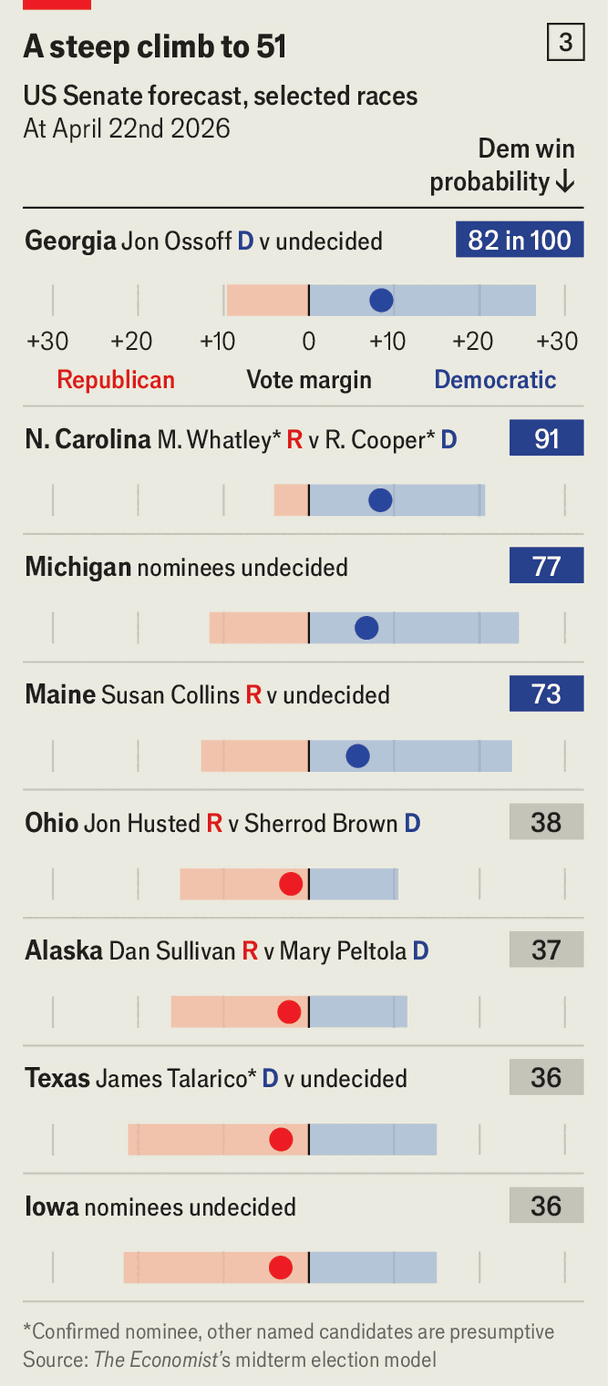
At the same time, Democrats have scored recruiting coups in two light-red states. Sherrod Brown, a longtime incumbent in Ohio, lost in 2024 but ran far ahead of Kamala Harris. He is now mounting a comeback in a far friendlier political environment, and polls show him nearly tied. Similarly, Mary Peltola, who won a statewide race for Alaska’s only House seat in 2022 but was narrowly defeated two years later, has led Dan Sullivan, the incumbent Republican, in all public polls this year.
Moreover, Republican primary voters in Texas could still oust John Cornyn, a mainstream incumbent, in favour of Ken Paxton, the state’s attorney general, who faced securities-fraud charges for nearly a decade and was impeached by his fellow Republicans in the state legislature. That would open the door to making Democrats’ long-held dream of “Blexas” more than something from which the party awakens every other November.
Our model sees Democrats as underdogs in all of these states, and in an open seat in light-red Iowa as well (see chart 3). However, any scenario in which they are doing well enough nationally to win even one of these states is probably also one in which they sweep the easier contests, putting them on the cusp of the decisive 51st seat. If anything, our forecast may be a bit conservative on Democrats’ Senate chances. Prediction markets already make them a narrow favourite to flip both chambers.■
Editor’s note: This article has been updated to include the result of Virgina’s referendum.