Ukraine’s quest for new friends takes it to Turkey and Syria
American unreliability is creating conditions for new alliances of convenience
 April 23rd 2026
Few foreign missions in Kyiv appear as dreary as Syria’s embassy. It is squeezed into a squat apartment block in Lukyanivka, a neighbourhood repeatedly targeted by Russian attacks. The façade of the hotel next door has been torn open by a Russian drone. The embassy has been closed since 2018, when Ukraine ordered it shut in response to war crimes committed by the regime of Bashar al-Assad, Syria’s former dictator.
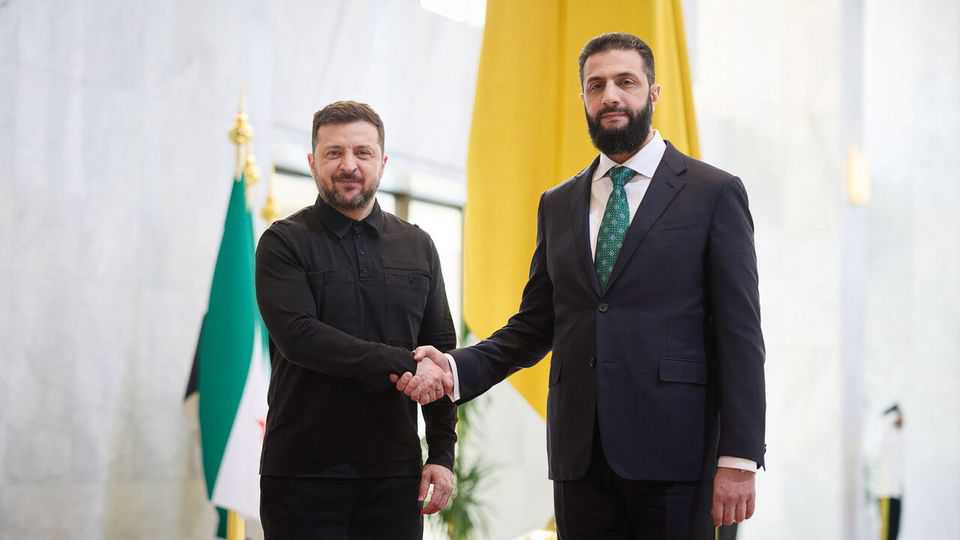
That will soon change. On April 5th Volodymyr Zelensky, Ukraine’s president, conducted a surprise visit to Damascus, and Syria said it would reopen the mission. Ukraine, for its part, says it will soon appoint an ambassador to Syria. The two countries restored diplomatic relations last September; Ukraine had severed them in 2022 after Mr Assad recognised Russia’s annexation of the occupied parts of the Donetsk and Luhansk regions.
The countries’ leaders make an unlikely pair. Mr Zelensky is a former comedian of Jewish descent. Ahmed al-Sharaa, Syria’s president, spent years commanding a branch of al-Qaeda. Yet they have found common ground, notably on trade. Syria has some of the world’s largest phosphate deposits, said to total roughly 2bn tonnes, which Ukraine hopes to use for agriculture. Ukraine has wheat, which Syria, impoverished by a more than a decade of civil war, badly needs. Mr Zelensky has suggested bartering one for the other.
Further down the line, Ukraine hopes for a security partnership. Syria needs help modernising its army, including its ageing Soviet-era weapons systems, and rebuilding its port and energy infrastructure. Ukraine’s engineers and military advisers worked in Syria during the cold war, and four years into Ukraine’s war with Russia it has become a defence-tech juggernaut. It would be keen to return, not least to taunt the Russians.
Russia was the main sponsor of the previous regime in Syria. It retains two military bases there, and has tried to preserve cordial relations with the new government. Vladimir Putin hosted Mr Sharaa in Moscow last year. But its influence has waned dramatically, and will continue to do so as long as it refuses to extradite Mr Assad. Having overseen the torture or killing of hundreds of thousands of Syrians, he absconded to Moscow when his government collapsed, and was granted asylum. Ukraine spies an opening. “We want to step into Russia’s fading footprint wherever we can,” says Yevgeniya Gaber, a former Ukrainian diplomat now with the Atlantic Council in Washington.
Turkey, Syria’s new gatekeeper, is happy to facilitate. President Recep Tayyip Erdogan’s government avoids open confrontation with Russia. But it benefits from the Russians’ diminishing sway in the Caucasus, the Middle East and Central Asia. That has led it to edge closer to Ukraine. Baykar, a pioneering drone firm in Turkey, is building a factory in Kyiv. Other Turkish defence firms are rumoured to be considering joint ventures, too.
Russia remains one of Turkey’s biggest trading partners and the source of a large share of its oil and gas imports. But the days when Mr Erdogan flaunted his independence from NATO by purchasing Russian military kit, notably an S-400 air-defence system in 2017, are long gone.
Ukraine still counts mainly on America and Europe for its security. But its cultivation of Turkey, a regional heavyweight with the second-biggest army in NATO, shows how American unreliability is creating new arrangements between middle powers. Mr Zelensky made the link explicit in a televised address on April 20th, arguing that because of the risk of American withdrawal from NATO, the European Union needs a security architecture that includes Turkey and Ukraine, which now has Europe’s biggest army (Russia aside).
Mr Zelensky’s visit to Syria was set up by Mr Erdogan, whom he had met the day before in Istanbul. He flew to Damascus on a Turkish government plane, alongside Turkey’s foreign minister. Like businessmen trying to impress a connection, the Turks were showing their new friend the neighbourhood.■