Mark Mobius dared to go where few others did
The emerging-markets fund manager died on April 15th, aged 89
 April 23rd 2026
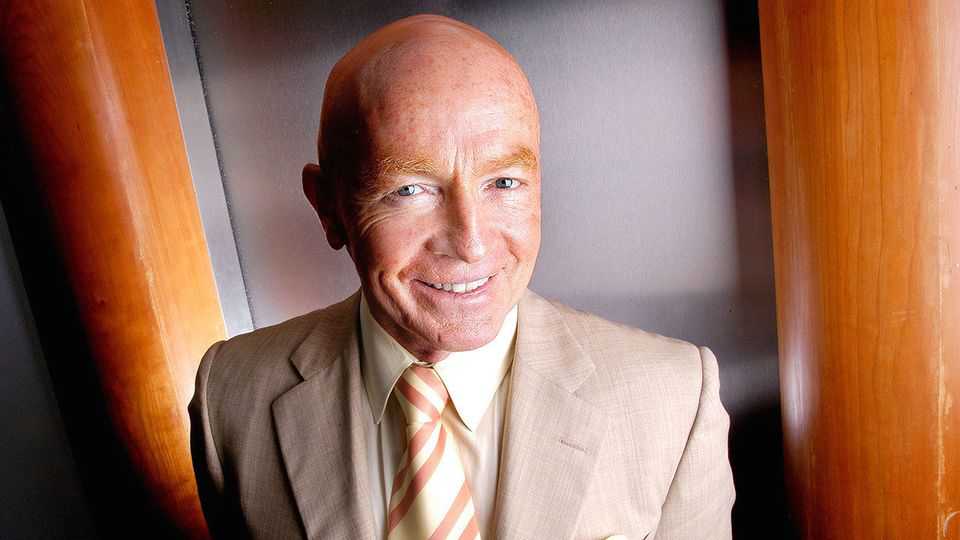
For a fund manager’s website, Mark Mobius’s was bizarre. No dollar signs, or stock-tickers, or serious men at desks. Instead it was a gallery of globetrotting snaps. There he was at the gateway to a Japanese temple, or wrapped up warm in Greenland, or strolling among the cafés of Buenos Aires and the pyramids of Teotihuacan. Here he was on a terrace in sunny Italy, enjoying a fabulous view while musing on the world economy. Everywhere (except in Greenland, where he preferred fur), he shone out in his white baseball cap and sempiternal tan. Everywhere, too, he wore the same smile, not of a holidaymaker (he never took holidays), but of a keen-eyed hunter on the track of treasure.
It could be found in unlikely places. Almost all other fund managers in the 1980s and 1990s plumped for dependable companies in rich nations. They avoided communist or socialist regimes, disorder, debt-riddenness, corruption, and faraway countries of which they knew nothing. Sensible enough, to them. But he, a determined optimist, took the opposite tack. A “bad” country unloved by investors might still contain enterprising people and companies well worth investing in. And the moment to go into that market was at the peak of chaos. Panic, crashes, blood on the streets, all made a fantastic scenario for him. Revolution was a chance to buy. When Russia hectically privatised in 1997, he visited 36 companies (oil, gas, diamond-mining) in three time zones.
The results of this strategy were striking. When he joined Franklin Templeton in 1987 to head their emerging-markets fund (old, in his 50s, to be starting in that job, though he had run an investment business for 20 years), he was managing $100m. When he left in 2018 he was managing $40bn scattered over 70 countries. His returns were not stellar: some stocks out-performed, some under-performed, in the usual way. Average annualised returns on the fund were a respectable 13.4%. For every ten picks, he reckoned, there would be one great success. And almost more important was that he gradually altered the psychology of investors and fund managers. Before him, they barely glanced at emerging markets. After him those markets, including Argentina, Brazil, Poland, Thailand and Vietnam, were in the mainstream asset class.
People called him Indiana Jones for his venturing, and he liked that. The world belonged to optimists; pessimists were only spectators. He took risks, obviously. In the Philippines, during a coup, bullets zinged around him. In the happy hunting-ground of Argentina’s wildly volatile stockmarket he, too, might trip up. But almost always the risks were calculated. Like a sumo wrestler, preparing for hours to seize a moment, he would not buy one share before he had read expert analysis on the country and been there himself. (He set up his first offices in Hong Kong and Singapore, places he already knew well.) Nor would he invest in any company before he had visited the factories, talked to the managers and met the workers.
That was what his travelling, 250 days in a year by one reckoning, was all about. He soaked in the culture as well as the business climate, confident that entrepreneurs could triumph everywhere if the legal system let them breathe. In Mexico, after struggling to the top of the Pyramid of the Sun, he went off to the Kimberly-Clark nappy-and-wet-wipes factory to check how things were going. (Well.) After a colleague’s wedding in Romania he called in on a factory where purified lead was processed into sheets. (Not so good; too much competition.) In India he envisaged a lively market in spices, thanks to the mobile phones of farmers and a new commodities exchange. As a foodie, he had to investigate a fish-ball-making plant in Thailand. But he also felt obliged, in Vietnam, to sample (surprisingly nice) scorpions on toast.
Visits like this could avert problems, though not always. In Brazil the Templeton fund invested in Mesbla, a chain of department stores that suddenly, in 1997, went bankrupt. He learned it from the newspapers. Earnings had been growing, the books looked fine. His fund had dealt with it for years. But the family who owned it had been taking assets out until it collapsed. After that he insisted on meeting owners, too.
China was perhaps his greatest frustration. He was one of the first in. Very slowly access got better, and he discounted the usual caveats. A trade war with America seemed distant to him, and Xi Jinping’s iron grip made the country stable. He was hobbled mostly by capital controls: money put in could not be got out. Yet he had fun, too, at a humbler level. On bone-jolting rural roads he tested out bicycles, and in the mountains of Fujian he climbed to watch the picking and processing of the best Oolong teas.
Full-time nomadism suited him, because he was a multinational sort. His father was German, his mother Puerto Rican. They barely knew each other’s languages, but he grew up, on Long Island, speaking both German and Spanish. At Boston University he saw a chance to study in Japan: he went, and fell in love with the East. Yet the world he had imagined for himself was the stage. As a young man he wanted to be a method actor, getting inside the psychology of a character. The actor bit made him a great TV showman, popping up regularly on CNBC with his blunt views, shaved head and stylish clothes. The psychology bit led on to persuading investors to take the plunge.
Obviously he did persuade them, and not just with the prospect of decent returns. There was a morally worthwhile side to this, which he had absorbed from Sir John Templeton, the fund’s founder. To prosper, countries needed a market economy open to foreign investment. With that, their people would thrive. Equal opportunity and the rule of law would spread around the world. All it needed was a keener Western appetite for calculated risk.
He never married, though. Who could possibly calculate the risks of that?■