How a Sudanese militia built a military and economic empire
Three years into Sudan’s civil war, the Rapid Support Forces has grown into a regional power
 April 23rd 2026
After days of heavy fighting, in March the Rapid Support Forces (RSF) captured Kurmuk, a town in south-eastern Sudan on the border with Ethiopia. Like much of Sudan’s civil war, the battle drew little notice abroad. Yet it could rank among the most consequential since the conflict began in April 2023. Besides turning Blue Nile, a state once remote from the fighting, into a pivotal battleground, it showed the effectiveness of the RSF’s alliance-building: in seizing the town, the paramilitary group collaborated with local rebels. Most striking was the apparent involvement of Ethiopia. For the first time the RSF appears to have staged an offensive from deep within the territory of one of Sudan’s neighbours.
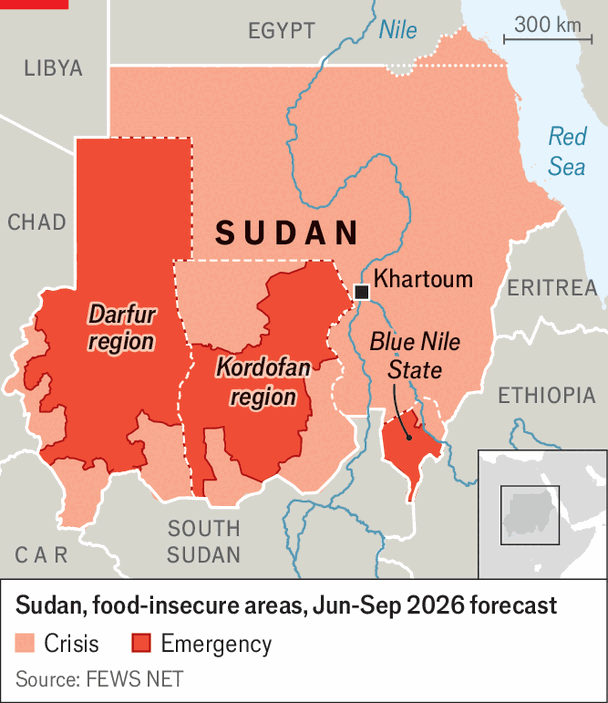
The battle illustrates the group’s transformation from an unusually well-armed and well-connected paramilitary unit into a transnational business-cum-military empire. As the war began the Sudanese Armed Forces (SAF), the national army, believed it would make short work of the fighters led by Muhammad Hamdan Dagalo, a warlord known asHemedti. Three years later the scale of that miscalculation is clear. More than 33m of Sudan’s 50m people require aid; at least 19m face acute hunger (see first map). Some 14m have fled their homes; perhaps hundreds of thousands have been killed. The economy is in ruins; the state has all but collapsed.
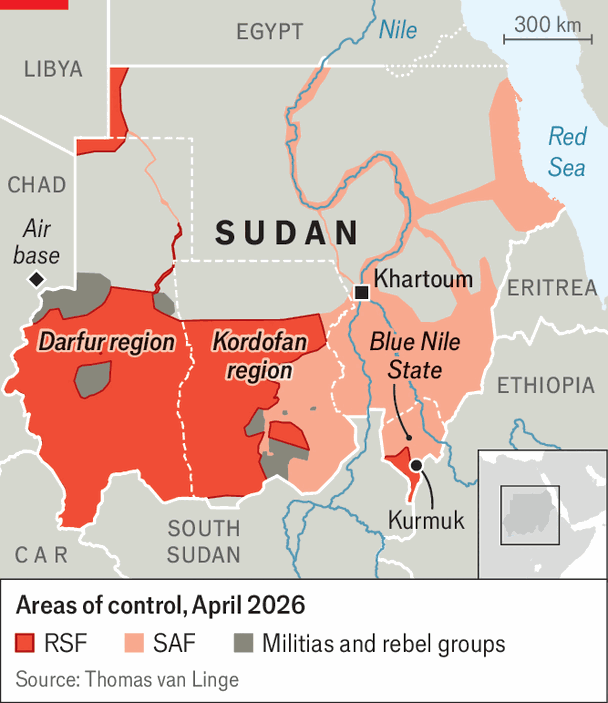
The RSF’s military and economic footprint, on the other hand, has grown. The SAF last yearreclaimed Khartoum, the capital, and the fertile Nile corridor. But the RSF and its allies still hold roughly half the country. That includes most of Darfur—the group’s mineral-rich stronghold where it is accused of committing genocide—and swathes of Kordofan and Blue Nile (see second map). Moreover, as the evidence of Ethiopian involvement suggests, the RSF’s influence, infrastructure and interests now extend beyond Sudan’s borders.
Since the early days of the war, the RSF has worked to secure flows of arms and fuel by weaving a web of airfields and logistics hubs in Sudan’s neighbourhood. At first, supplies moved chiefly through Amdjarass, an airbase in Chad that the United Arab Emirates (UAE)—the RSF’s chief foreign backer—is said to have used to funnel weapons and medical aid into Darfur. (The UAE acknowledges providing some early support to the RSF, but denies it is still doing so.) In 2025 the centre of gravity shifted to southern Libya, where Khalifa Haftar, a Libyan warlord and ally of Mr Dagalo, facilitated supplies.
More recently, Ethiopia and the Central African Republic have become important conduits. Yet with the exception of Egypt and Eritrea, which are aligned with the SAF, every country bordering Sudan allows the RSF to operate in some way on its territory. Partly, that is because all have strong ties to the UAE. The RSF has also persuaded them it is worthwhile by investing in its own commercial and diplomatic networks across the region.
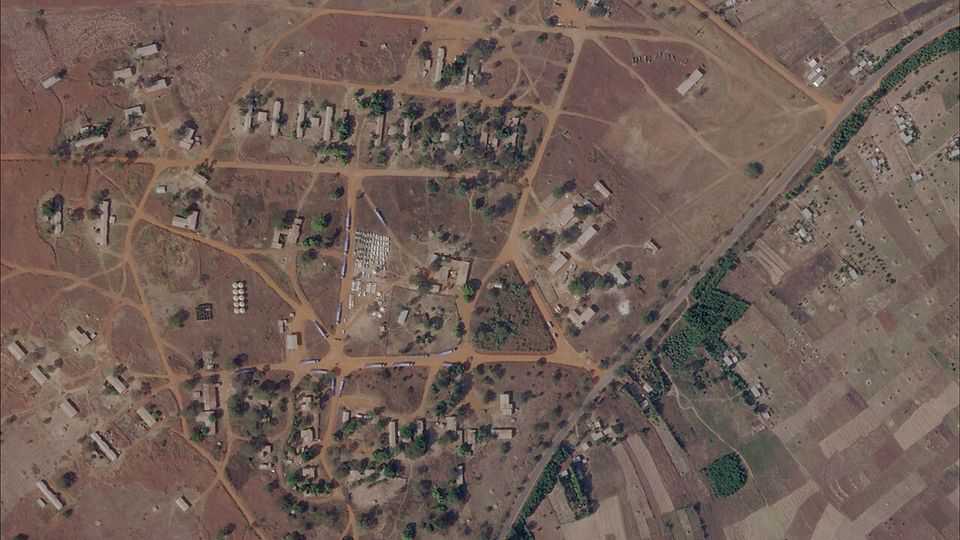
Ethiopia gives it the most latitude. Since late 2025 the group’s military’s footprint there, in the far west near Kurmuk, has allegedly included a camp to train thousands of its fighters. Satellite imagery (pictured) analysed by Yale University’s Humanitarian Research Lab points to the presence at an Ethiopian army base of, among other things, vehicles resembling those deployed in Kurmuk.
Yale says its findings show “clear visual evidence” that the RSF is launching attacks from inside Ethiopia. The Ethiopian government did not respond to the allegations; the UAE says it “categorically rejects” claims that it has provided “weapons, funding, trainers or logistical support to the RSF”. The RSF refuses to comment.
African countries that do not border Sudan also appear to be assisting the RSF. Credible evidence suggests the Ugandan army may have helped move weapons and fuel to the group through South Sudan, says Joshua Craze, a British researcher. Last year an investigation by Bellingcat, an open-source intelligence collective, identified Kenyan-labelled crates of ammunition inside an alleged RSF weapons depot near Khartoum. RSF officials live and move freely in both Uganda and Kenya.
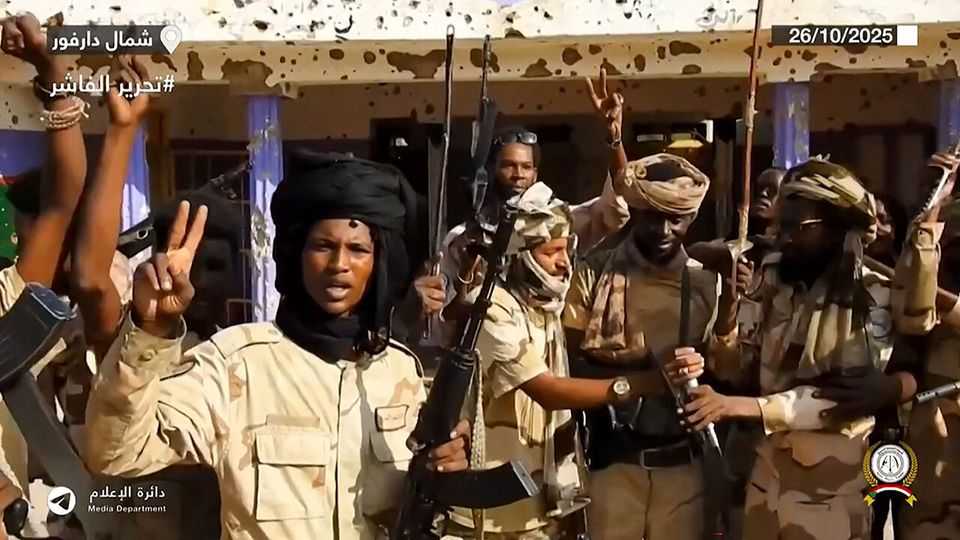
The group also recruits from far and wide. Abdelnasser Solum Hamed, a Sudanese analyst, says it offers fighters across the Sahel around $500 per month to serve in its ranks, a good wage by local standards. Some come from farther afield. Since 2024, hundreds of Colombian mercenaries have helped the RSF fight in Darfur. They travel via an air bridge that spans the UAE, Chad, Libya and the semi-autonomous region of Puntland in Somalia. During a visit in 2025 The Economist saw a cargo plane at the airport in Bosaso, Puntland’s main port. It was registered to Kyrgyzstan but, according to conflict monitors, is controlled by the UAE. On your correspondent’s flight were about a dozen burly men speaking Spanish. A new report by the Conflict Insights Group, an analysis firm, shows that support from UAE-backed Colombian mercenaries enabled the RSF to capture el-Fasher, a city in Darfur, in October 2025.
The RSF’s military prowess is made possible by its deep pockets. In 2017 Mr Dagalo, who started out as a camel trader and commander in the Janjaweed militias, the RSF’s forerunners, notorious for their slaughter of black African ethnic groups in the 2000s, seized control of Darfur’s largest gold mine. The exports enabled him and his family to buy up private and public assets. By the time the war erupted in 2023 Mr Dagalo was Sudan’s de facto vice-president and one of its richest men.
His business empire straddles the Horn of Africa and the Red Sea. According to a forthcoming report by the Sentry, an American investigative group, members of the Dagalo family and companies linked to the RSF own more than 20 properties in Dubai, worth $24m in total. The group also says a network of UAE-based companies enables the RSF leadership to turn smuggled gold into hard currency. Nick Donovan of the Sentry reckons the findings are only a small part of a “paramilitary-industrial complex”.
According to Mr Donovan, the Dagalo family declined to comment on whether its members still owned specific properties, and said that any private residences or assets had been properly obtained. The family also stressed that members had been engaged in legitimate commercial activity, such as livestock trading, for generations.
The RSF’s business interests have proved resilient. In 2025 America put sanctions on seven companies based in the UAE which it said had provided money and weapons to the group. Nonetheless, it has expanded into new mining areas.
The latest Gulf war is strengthening the RSF’s hand. The UAE regards influence and resources in Sudan and the wider Red Sea region as crucial to its security, and considers the RSF an important vehicle for acquiring them. Attacks by Iran against Gulf states reinforce that logic, notes a former American diplomat. Abdel-Fattah al-Burhan, Sudan’s army chief, has condemned Iran’s strikes. But the SAF buys drones from Iran, and is allied with Islamists who support the Islamic Republic.
The Iran war has also made America even less inclined to put pressure on the UAE. On April 17th it imposed new sanctions on two Colombian companies which, it says, supply mercenaries to the RSF, but not on the UAE-based security firm that is accused of paying and training them. Even if that changed, the RSF’s vast commercial network means that persuading the UAE to cut its support would not swiftly end the war, says Kholood Khair of Confluence Advisory, a Sudanese think-tank.
Increasingly, the RSF seeks to be seen as a legitimate power. Last year it announced a parallel government. The SAF’s insistence that the group must withdraw unilaterally from territory it occupies has stalled efforts to secure a truce. Undeterred, in January General Burhan called once again for the RSF to be “eliminated”. That seems more remote than ever.■