Donald Trump’s bold new deportation machine
Coming to America, going to Angola
 April 23rd 2026
Teodoro (“Teddy”) Obiang junior was once on America’s naughty list. More than a decade ago prosecutors charged the son of the dictator of Equatorial Guinea, a small African petrostate, with extortion and embezzlement. They let him keep his ill-gotten Michael Jackson memorabilia (fedora, glove, “Thriller” jacket) but seized his Malibu mansion and Ferrari and restricted his ability to enter America. Until last year, when the Trump administration welcomed him back.
In September Mr Obiang moonwalked into a meeting with the deputy secretary of state, Chris Landau, in Washington. They discussed energy and security: salient topics, given Equatorial Guinea’s cosy relationship with China and Russia. They also talked about illegal immigration. This was curious. The tiny country is no real source of illegal migrants to America.
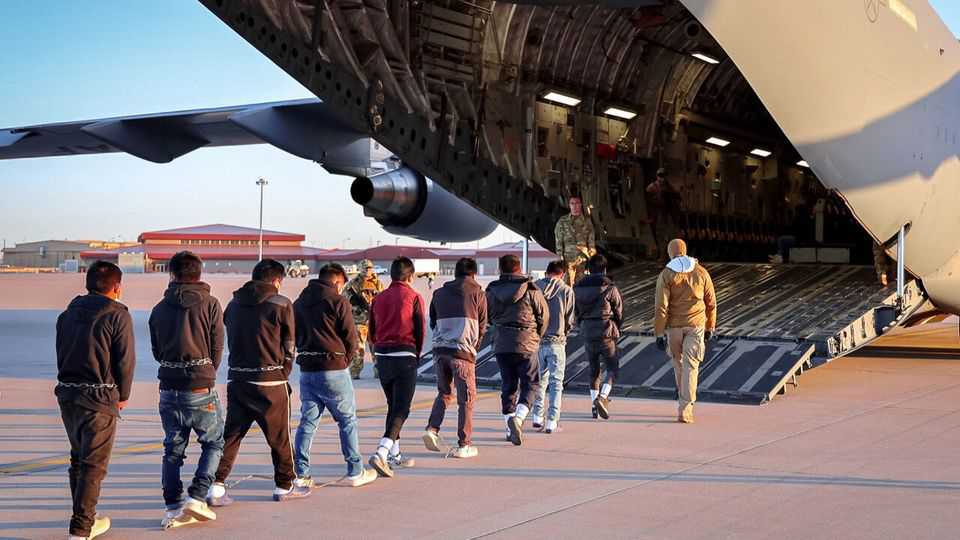
Clarity came in November when a plane carrying nine illegal immigrants left Louisiana and landed in Malabo, the former capital. Not one was from Equatorial Guinea; they were citizens of Angola, Eritrea, Georgia, Ghana and Mauritania. The men were locked in a hotel owned by one of the president’s brothers and pressed to go to their home countries, from which they had fled. After a month in detention Jonathan (not his real name) was frog-marched onto a plane home, where he had been tortured by gangs because he is gay. He is now in hiding.
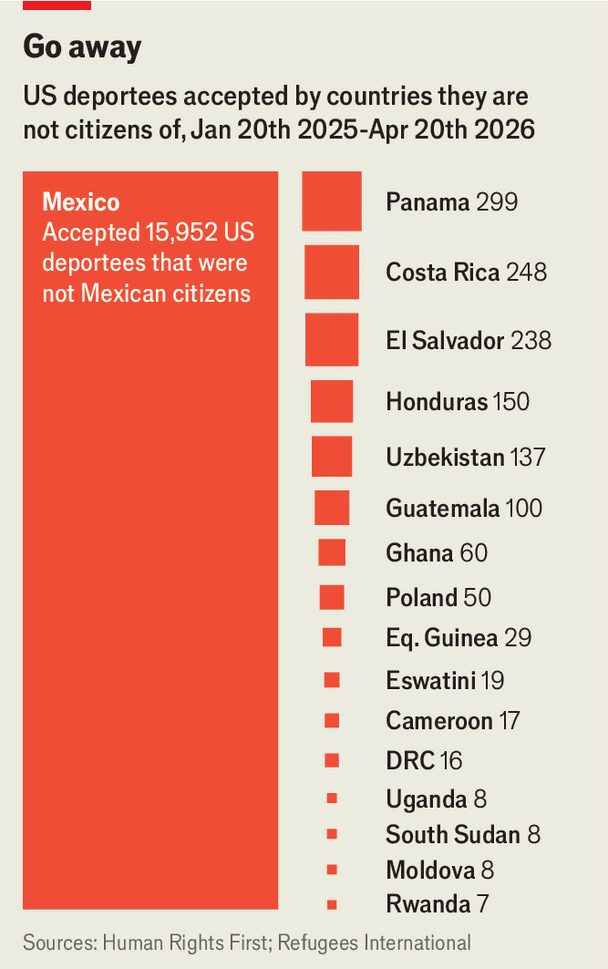
Such are the innovations of Donald Trump’s mass deportation campaign. At least 16 countries, mostly in Africa and Latin America, have accepted deportees from America who are not their own citizens. Another 11 have inked such “third-country” removal deals. Their number is growing—last week a group of Colombians, Ecuadorians and Peruvians landed in the Democratic Republic of Congo. And the administration wants to send 1,000 Afghan refugees, who once helped America fight the Taliban, from a camp in Qatar, where they are currently housed, to Congo.
The agreements vary. Some countries are offering asylum to the arrivals (eg, Honduras and Uganda). Others are rehabilitating and integrating released criminals (Rwanda). Still others are acting as jailers before carrying out their own deportations (Equatorial Guinea and Ghana). Together they illustrate Mr Trump’s transactional diplomacy—the deportation imperative turns all countries, even autocratic ones, into valued partners. Two diplomatic sources say that early last year ambassadors were encouraged to tell foreign governments: help us on immigration and we’ll help you.
The sweeteners—or the arm-twisting—vary too. Equatorial Guinea and Rwanda each got $7.5m. A $30m grant to the UN High Commissioner for Refugees (UNHCR) in Cameroon was contingent on that country signing a deal. Ghana got some visa restrictions loosened. So did Liberia after it agreed to accept Kilmar Abrego Garcia, a Salvadoran man whom the Trump administration has tried unsuccessfully to deport. Mr Trump stopped talking about seizing the Panama Canal after Panama took 300 people from places as far-flung as Iran, Nepal and Somalia. Mexico’s decision to accept more third-country deportees than anywhere else comes against a backdrop of trade negotiations and Mr Trump’s threats to bomb drug gangs.
America is hardly the first Western country to try to dump unwanted immigrants abroad, though few have had much success. Courts blocked Britain’s deal with Rwanda; Italy’s with Albania has not yet amounted to much. Before Mr Trump no American president had tried sending immigrants to third countries on a large scale. The law allows it, and America has long had a deal with Canada. But his practice of it is legally dubious.
Under international law America must protect asylum-seekers from “refoulement”, deportation to countries where they fear persecution. Deportees are also meant to get the chance to challenge a removal in court. Now American immigration officials are dumping them in repressive countries and saying sayonara. Jonathan’s case is emblematic. An immigration judge ruled he could not be sent to his home country, but that did not preclude him from being sent elsewhere—and then refouled.
Turning a blind eye is practically policy. Diplomats admit that they refrain from enquiring after the deportees’ welfare. Last year a federal judge asked if the Department of Homeland Security (DHS) thought it was acceptable to send someone to a third country without warning “as long as [it] doesn’t already know that there’s someone standing there waiting to shoot him”. “In short, yes,” came the government’s reply. The judge’s order requiring DHS to give notice to prospective deportees and hear challenges is on hold pending appeal.
Republicans argue, not unreasonably, that America’s asylum system is gameable. Some illegal immigrants have been ordered removed by judges but cannot be deported because their home countries will not accept them. In pre-Trump times they could expect to live freely in America, albeit without a path to citizenship. Mr Trump is using the threat of third-country removals to press unco-operative governments to accept their own citizens. Otherwise they might wind up in South Sudan, as happened to several men convicted of crimes in America whose home countries (Cuba and Vietnam, among others) would not take them back.
Yet for all the cash and diplomatic capital expended on these deals, only 17,000 people have actually been deported to third countries. By contrast, total removals numbered 234,000 over the past six months, the vast majority to people’s home countries. The truth is that no place wants to be America’s mega-processor. “No one was willing. There’s not much of a win-win you can articulate,” says an American former national security official.
If anything the aim is to get immigrants to “self-deport” and deter others from coming. The schemes are one more knock to the asylum system, to which the Trump administration has taken a sledgehammer. Denial rates have more than doubled; the president’s nominee to be deputy head of the UNHCR wants America to withdraw from the global refugee pact. Alma David, a lawyer, says the spectre of third-country removals is doing what it was intended to do: “scare the shit out of people”.■