Britain rethinks its “special relationship” with America
Seventy years after the Suez crisis, the Middle East brings a new reckoning
 April 23rd 2026
KING CHARLES III’s trip to America on April 27th-30th is ostensibly to commemorate the 250th anniversary of America’s independence from Britain. It is turning into a mission to help salvage the countries’ “special relationship”, as Winston Churchill called it in 1946. At stake is Britain’s place in the world: should it keep hugging America, or embrace Europe?
The king faces fallout from the scandal around the late Jeffrey Epstein and the sex-trafficker’s connections to the British elite, not least the monarch’s brother, Andrew Mountbatten-Windsor, and a former ambassador to Washington,Peter Mandelson. More pressing is whether the royal charm can bring respite from the bad blood between British and American leaders. Donald Trump has lost patience with Britain over Iran (“When we needed them, they weren’t there”); Sir Keir Starmer has tired of flattering Mr Trump (“I’m not going to yield” to American pressure, he told Parliament this month).
It is the worst rift between the allies since the Suez crisis of 1956, when Britain, France and Israel attacked Egypt to seize the Suez Canal and overthrow its nationalist leader, Gamal Abdel Nasser; American ire forced them to withdraw. Now America has allied with Israel in a war against Iran; European allies are aghast but powerless to stop the turmoil.
For a time Sir Keir got on with Mr Trump. At their meeting in the White House in February 2025 he proffered an invitation for Mr Trump to make an unprecedented second state visit to Britain. In May they reached a deal to reduce Mr Trump’s sharp tariffs. A NATO summit in June passed off well, too, as allies pledged to increase defence spending to 3.5% of GDP by 2035 plus a further 1.5% on defence-related infrastructure. Mr Trump cast himself as NATO’s saviour. At Windsor Castle in September the president waxed lyrical: America and Britain were “like two notes in one chord, or two verses of the same poem”.
Alas, the poetry is gone. Mr Trump was irked by European resistance to his wooing of Russia at the expense of Ukraine, and to his renewed demand to annex Greenland, a Danish territory. The war in Iran brought matters to a head. Mr Trump denounced Europeans as “cowards” for restricting the use of their bases and refusing to help reopen the Strait of Hormuz. Britain is hardly the only target of his wrath, but his broadsides carry particular force because of the countries’ historical closeness.
Always more special to Britain than to America, the relationship is being rent by many forces. Britain’s role as a bridge between America and Europe, questionable at the best of times, has collapsed with Brexit. America has wanted to turn from Europe to constrain a rising China. To exacerbate matters, Mr Trump has a contempt for rules and alliances that Britain holds dear. MAGA’s online echo chamber, moreover, portrays Britain as a land of violent crime and rampant Islamism.
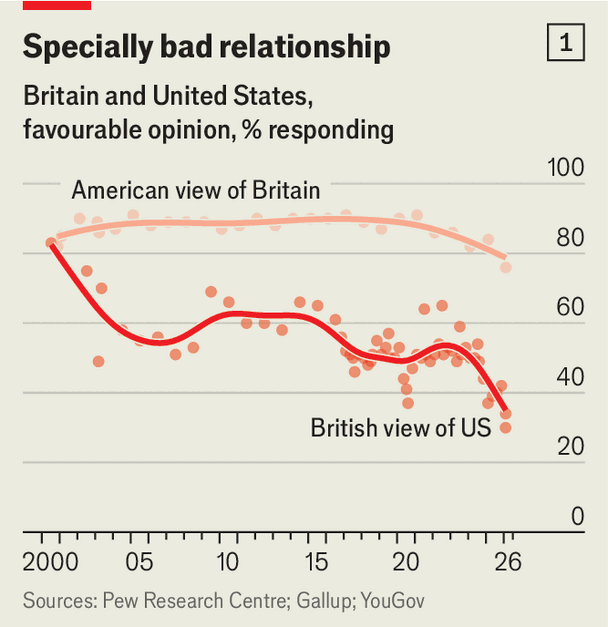
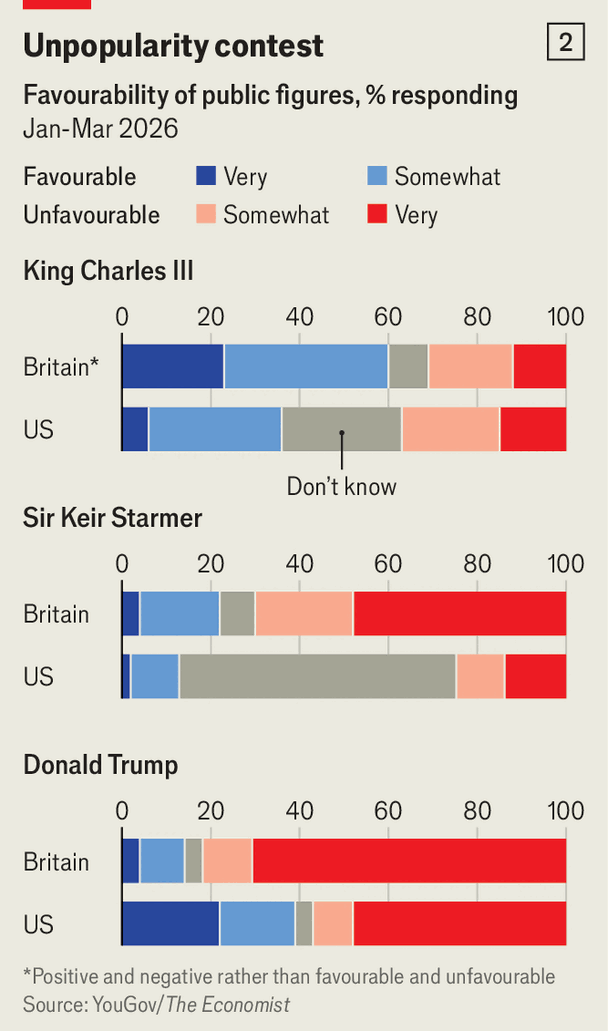
The American and British publics are growing disenchanted. Opinion polls suggest Americans and Britons still held each other in high regard at the turn of the century, with more than 80% of respondents in each country saying they had a favourable view of the other (see chart 1). Americans’ approval of Britain has fallen from 91% to 76% in the past five years. Britons’ opinions have deteriorated more gradually but farther: just 34% now express a positive view of America. Americans and Britons alike give higher ratings to other countries, such as Denmark, France and Japan. American and British views of each other’s most prominent public figures are not exactly flattering either (see chart 2).
Senior British figures say relations with America are, like the sea, “choppy on the surface but calm below”. Mr Trump and Sir Keir may see political advantage in jabbing at each other, but their subordinates still work well together, not least in military and intelligence matters. One problem for Britain is that Republicans who normally defend allies also tend to be hawkish on Iran and irritated by Europeans’ qualms.
A persistent criticism concerns the hollowing out of Britain’s armed forces. Britain boasts a nuclear deterrent, albeit one dependent onextensive American help, along with two aircraft-carriers, F-35 stealth jets, nuclear-powered attack submarines, deployable land forces, top-notch special forces and more. But the reality is less impressive. Britain deployed an armoured division (about 26,000-28,000 troops) as the main formation fighting alongside Americans against Iraq in 1991 and 2003. These days, a senior officer admitted publicly, it would struggle to send even an armoured brigade (3,000-5,000 troops). Air-defence and artillery batteries are woefully short, too.
The aircraft-carriers have had problems with their propeller shafts and are both tied up for maintenance (Mr Trump recently derided them as “toys” compared with America’s). Britain ended its permanent naval presence in the Gulf earlier this year, and struggled to muster a destroyer to help protect Cyprus last month. Just two of seven frigates and one of five active attack submarines are thought to be deployed. The air force’s F-35s lack long-range weapons, such as Storm Shadow cruise missiles used by older Typhoon jets.
Insiders admit that British forces “are naked” when not fighting together with American ones, whose might has hidden many of Britain’s gaps. They note that equipment programmes are underfunded by £28bn ($38bn), even before new requirements from last year’s strategic defence review (SDR) are added. A ten-year defence-investment plan, promised last autumn, has yet to be published, prompting George Robertson, a former NATO secretary-general and co-author of the SDR, to denounce “corrosive complacency”. These days the Trump administration refers to Israel, not Britain, as America’s “model ally”.
Co-operation in intelligence is more equal. In Ukraine, Britain has been willing to take more risk than America in sending officers to liaise with Ukrainian ones, gaining better insight on the fighting. Britain is part of the “Five Eyes” intelligence partnership (with America, Australia, Canada and New Zealand). But this, too, is being questioned. Britain stopped sharing intelligence on Latin American drug gangs when America started to sink alleged drug-running boats with missiles. Mark Dubowitz of the Foundation for Defence of Democracies, a hawkish American think-tank, provocatively suggested America should give up on Five Eyes in favour of a new pact with Israel, Poland, Ukraine, the United Arab Emirates, Japan and South Korea.
Britain is thus being forced to reconsider the lessons it drew from Suez. Whereas France decided an untrustworthy America must be kept at arm’s length, Britain resolved not to be parted from America again. Britain long had the better of the argument. But now France looks vindicated and Britain dangerously exposed.
Peter Ricketts, a former British national security adviser, argues that Britain must “rebalance its relationship” with America by moving closer to fellow Europeans. Some officials still hope that, as happened after Suez, America will turn back to its British friend. Yet even a more sympathetic successor to Mr Trump will expect Europeans to do a lot more to defend the Atlantic as America turns to the Pacific.
Vladimir Putin ended Britain’s long peacetime dividend. Mr Trump is scuppering notions of its special place in the world. He will courteously welcome the king, but has made it plain that he sees Britain as a much diminished power.■