As the World Cup approaches, North American relations are at a nadir
President Donald Trump has wrecked the dream of a more united region
 April 23rd 2026
When in 2018 Canada, Mexico and the United States won their bid to host this year’s football World Cup jointly, the slogan was “United As One”. Aspirational as slogans are, this one was not absurd. North America is home to more than 500m people, accounts for roughly a third of global GDP and enjoys several big advantages: democratic governments, peaceful borders and economies with different strengths that are now deeply integrated.
But with less than two months before kick-off on June 11th, North America’s unity is under strain. The discord can be heard most clearly in its leaders’ language. President Donald Trump has threatened direct action against drug gangs in Mexico, saying his counterpart Claudia Sheinbaum is “very frightened” of them. He has repeatedly suggested making Canada the 51st state. Mark Carney, Canada’s prime minister, has responded by calling his country’s close relationship with its neighbour a “weakness”. The rift goes beyond words. One of Mr Trump’s first actions on returning to office last year was to impose tariffs on his neighbours’ exports to the United States.
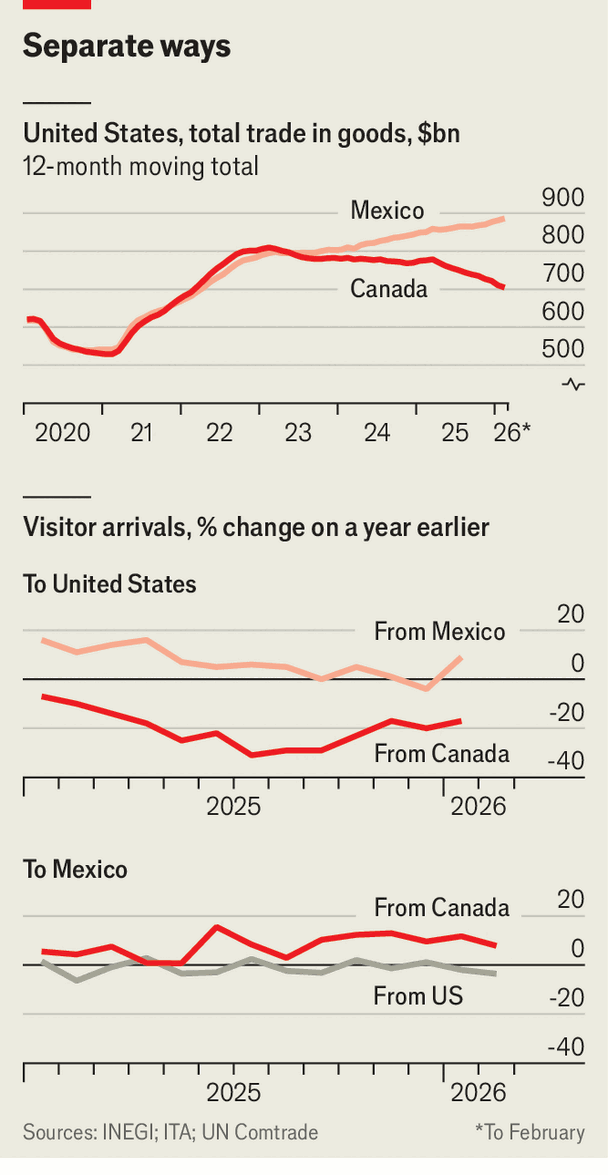
Tensions will come to the fore this summer. On July 1st, with the tournament still under way, the trio must decide whether to extend the United States-Mexico-Canada Agreement (USMCA)—the trade deal negotiated by Mr Trump in his first term—beyond its current expiry date of 2036. Since the first North American free-trade deal came into effect in 1994, commerce has flourished (see chart). Mr Trump’s tariffs have disrupted but not stopped the flow of goods. Today trade between the three countries is worth more than $2trn a year, estimates Diego Marroquín of the Centre for Strategic and International Studies, a think-tank in Washington, DC. Supply chains span the continent. A car may cross an international border during its assembly eight times before it is finished.
An extension was once thought to be all but certain. Yet Jamieson Greer, the US trade representative, who arrived in Mexico for talks on April 20th, is clear that a straightforward continuation is unlikely. Some of Uncle Sam’s objections are familiar. It wants tighter rules of origin for cars, chiefly to make it harder for Chinese parts to be used in their manufacture, and hopes to sell more dairy goods to Canada, which protects its farmers. The United States is already negotiating with Mexico, but it reportedly wants upfront concessions from Canada before starting formal talks.
Other demands are new and broader. Tariffs now apply not only to goods outside the agreement but also to steel, aluminium and cars that fall within it. The United States will demand that these stay. Mr Trump also wants greater co-operation on migration, security and competition with China. He is using the USMCA as leverage to press his neighbours into complying with his priorities. Given the size of America’s economy—its GDP is seven times bigger than Canada’s and Mexico’s combined—he is in a strong position to do so.
Michael Camuñez, who was a commerce official in Barack Obama’s administration, says the deal is “on life support”. It will probably survive, though weakened. A likely outcome is that the trio will agree to review the deal annually, while the United States uses other tools—tariffs justified on national-security grounds, forced-labour investigations and regulatory pressure—to extract concessions, reckons Mr Marroquín. That will spook industry.
The North American project was faltering before Mr Trump’s second term. “I tell people, ‘Don’t fool yourself thinking if Trump goes, all will be OK’,” says Martha Bárcena, a former Mexican ambassador to the United States. Annual leaders’ summits ended during Mr Trump’s first term and never resumed. Even a Democratic president would probably be eager to secure the border and fight Mexican gangs.
Mexico and Canada have taken different approaches to Mr Trump. Ms Sheinbaum has done everything possible to keep alive the idea of a more integrated North America. She has conceded to Mr Trump on migration and security. She has no other choice. Some 85% of Mexico’s exports go to the United States. The USMCA sustains the formal, relatively well-paid jobs that help fund the social programmes which keep Morena, her party, popular.
Canada’s approach is sharply different. Mr Carney describes the moment as a “rupture” and wants to reduce Canada’s reliance on a single partner. To that end he wants to increase trade with Europe, Asia and even China, which he visited in January. The pivot is so far symbolic. Louise Blais, a former Canadian diplomat, reckons it will barely “move the needle” on trade. Roughly 70% of Canadian exports go south, though they have fallen slightly. Even where commerce continues unhindered, many Canadians are angry enough they are boycotting American goods and avoiding trips south, which fell by about a quarter last year (see chart).
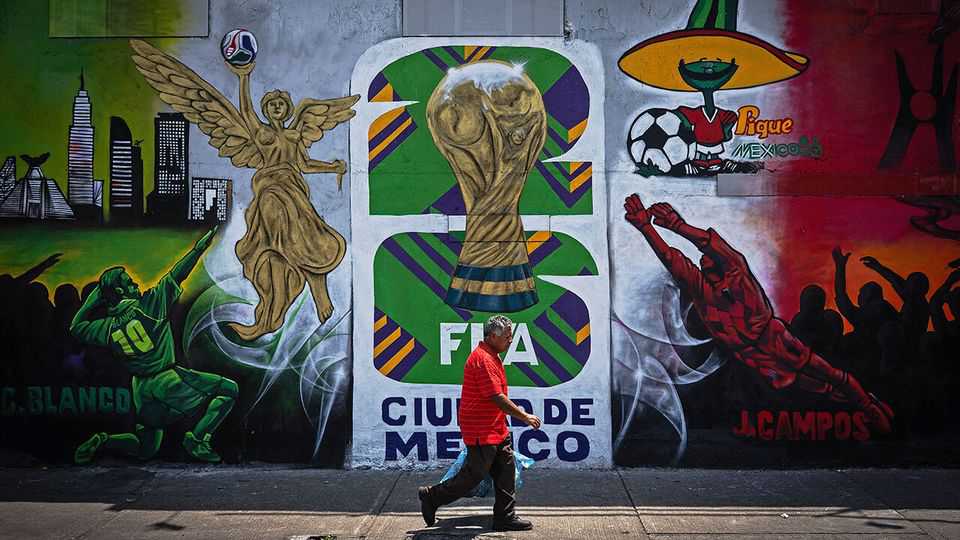
The World Cup illustrates the discord. National merchandise is far more widespread than any joint material. An American travel ban affects fans from 19 countries, some of whom will be unable to attend matches in the United States. Many fear American agents will use the matches to round up immigrants without papers, many of whom are Mexican. Hospitality workers at a stadium in Los Angeles where games will be played are threatening to strike unless federal immigration agencies vow to stay away from the competition.
Still, North America is so integrated that much will survive. The United States imports over 15% of its goods from Mexico, a bigger share than it gets from any other country. Despite tariffs, new supply chains are being created, including for high-tech goods such as data-centre equipment. On April 15th Mr Trump granted a permit to a Canadian company to run an oil pipeline to North Dakota. Competition with China has made Mexico and Canada more important as trade partners for the United States, not less.
The strain has also pushed the United States’ two neighbours closer together. Canada sent its largest-ever trade mission to Mexico this year; a Mexican delegation is expected in Canada soon. Even if the infrastructure for serious bilateral trade is not there—“Lettuce and broccoli from Mexico to Canada can’t happen as it stands,” says Mr Marroquín—the two governments are deepening their ties.
Trade and geography still bind North America. But the ideas that once animated its leaders have faded. The World Cup may bring feel-good moments, but it will fall short of what many hoped for in 2018. “The games were proposed and motivated by this dream of this integrated, competitive North America, but the ground shifted,” says Mr Camuñez. “I’d like to believe the three amigos will ride again some day.”■